Senior citizens in Israel may be eligible for significant tax benefits on pensions, interest income, capital gains, rental income and additional sources of income. Some benefits are available from age 60, others depend on reaching retirement age, and some are subject to additional age and income conditions.
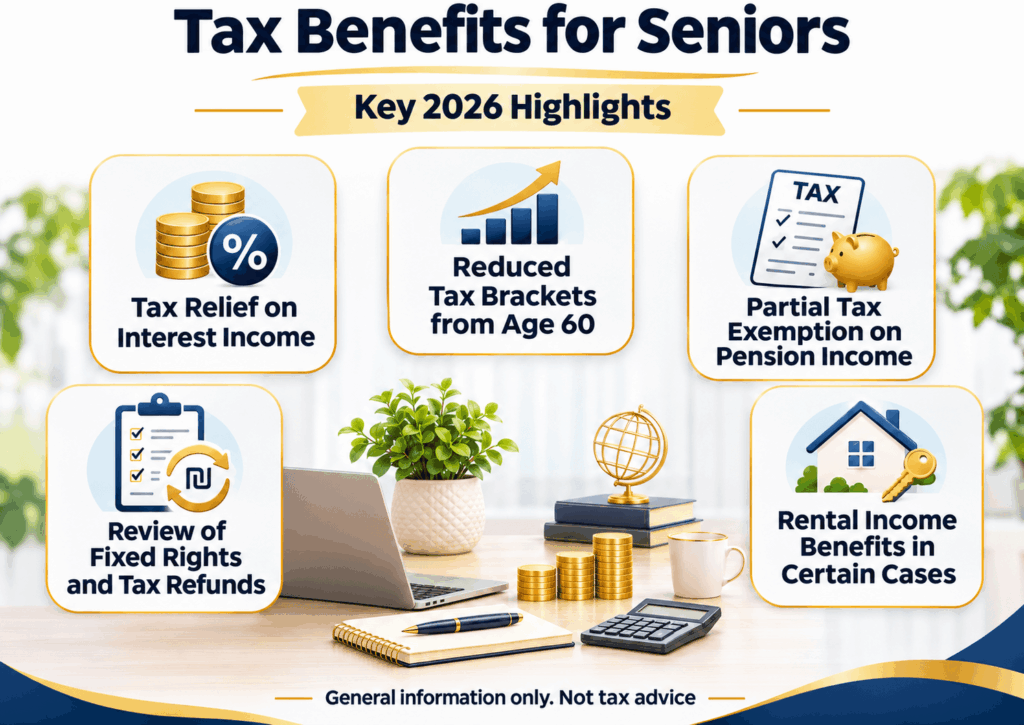
In 2026, the maximum tax exemption on a qualifying pension reaches 5,422₪ per month, subject to the conditions set out in law. In addition, there are tax benefits on income from savings and investments, tax credit points and other reliefs.
In this article, we will review the main benefits, eligibility conditions and ways to claim them
Tax Exemption on Pension Income and Fixation of Rights in 2026
One of the most significant tax benefits at retirement age is the tax exemption on pension income. Under Section 9A of the Income Tax Ordinance, a person who has reached the eligibility age may be entitled to a tax exemption on part of the qualifying pension received from a pension fund, executive insurance policy or budgetary pension arrangement.
The eligibility age is the statutory retirement age or the age at which the individual began receiving a qualifying pension, whichever is later. The retirement age for men is 67, while the retirement age for women is gradually increasing from 62 to 65, according to year of birth. For example, the retirement age for women born in 1963 is 63 years and 3 months, for women born in 1966 it is 64, and for women born in 1970 and onward it is 65. There are also arrangements regarding early retirement due to disability, in accordance with the conditions set out in law.
In 2026, the maximum exemption rate is 57.5% of the qualifying pension ceiling, which is 9,430₪ per month. This means a tax exemption on pension income of up to 5,422₪ per month, subject to the eligibility conditions and the use of other retirement tax benefits. The remaining taxable pension is taxed according to the tax brackets and tax credit points of the pension recipient.
For example, a pensioner who receives a monthly pension of 10,000 ₪, did not receive tax-exempt retirement grants that affect the exemption, and did not use the exemption for pension capitalization, may be entitled to an exemption on 5,422 ₪ of the pension. In that case, the taxable portion of the pension would be 4,578 ₪ per month, before taking into account tax credit points and additional benefits.
What Is Fixation of Rights and How Does It Affect Pension Taxation?
Fixation of rights is a process conducted with the Israel Tax Authority. As part of this process, the manner in which the retiree’s tax benefits are used is determined, including benefits relating to the monthly pension, retirement grants and pension capitalization, meaning a lump-sum withdrawal from pension savings.
As part of the process, which is carried out using Form 161D, various matters are reviewed, including tax-exempt retirement grants previously received, previous capitalizations, and the choice between using the exemption for the ongoing pension or for a tax-exempt lump-sum withdrawal. These decisions may affect the amount of the tax exemption throughout the retirement years.
Fixation of rights can also be carried out after the retirement date. In appropriate cases, tax refunds may be requested for previous years, up to six years retroactively, subject to law. Therefore, even a person who is already receiving a pension and paying tax on it may benefit from reviewing their eligibility.
For more information, see the Israel Tax Authority’s guide to fixation of rights for 2026.
Tax Bracket Benefits for Income Not Derived from Personal Exertion
Israel uses a progressive tax system, under which the tax rate increases as taxable income rises. Taxable income, after deductions, offsets and exemptions, is divided into brackets, with a different tax rate applying to each portion.
The Income Tax Ordinance distinguishes between income derived from personal exertion, such as salary or business income, and income not derived from personal exertion, such as certain rental income.
Under Section 121(b) of the Income Tax Ordinance, the tax brackets for income derived from personal exertion begin at a rate of 10% and increase according to the level of income. By contrast, under Section 121(a), the regular tax brackets for income not derived from personal exertion begin at a rate of 31%.
Reduced Tax Brackets for Income Not Derived from Personal Exertion from Age 60
Under Section 121(b) of the Income Tax Ordinance, an individual who turned 60 during the tax year or before it is entitled to have the reduced tax brackets, beginning at 10% rather than 31%, apply also to taxable income that is not derived from personal exertion.
In 2026, the reduced tax brackets are:
Tax rate | Annual taxable income |
10% | Up to 84,120 ₪ |
14% | 84,121 to 120,720 ₪ |
20% | 120,721 to 228,000 ₪ |
31% | 228,001 to 301,200 ₪ |
35% | 301,201 to 560,280 ₪ |
47% | Over 560,280 ₪ |
*These brackets apply to total taxable income, and not separately to each source of income.
Surtax on high income – taxable income exceeding 721,560 ₪ per year is also subject to an additional tax (surtax) at a rate of 3% on the portion of income above the ceiling. In addition, from 2025 onward, an additional tax at a rate of 2% applies where taxable income from capital sources, in and of itself, exceeds 721,560 ₪ per year, on the excess portion of the capital income. Accordingly, high capital income may be subject to a total surtax rate of 5%, in accordance with the conditions of Section 121B of the Income Tax Ordinance. These additional taxes are not included in the rates shown in the table.
For more information, see Israel Tax Authority Implementation Instruction 5/2025 regarding surtax.
The reduced tax brackets may also be relevant to capital gains from the sale of securities and to interest income, subject to the provisions of law and the tax ceilings applicable to each type of income. However, the calculation also takes into account additional taxable income, so not every capital gain of a person over age 60 will automatically be taxed at 10%.
Where tax was withheld at source at a rate higher than the tax that applies after calculating all income, it is advisable to examine eligibility for a tax refund.
Tax Exemption on Rental Income from an Asset Used by the Taxpayer in a Business
Section 9D of the Income Tax Ordinance grants, under certain conditions, a tax exemption on 35% of preferred rental income received by an individual after retirement.
The benefit is intended for income from renting out an asset that was owned by the individual and was used by them directly to generate income from a business or vocation in Israel before it was rented out. The benefit may be relevant to real estate assets and to other rights where the income from renting them is classified under Sections 2(6) or 2(7) of the Ordinance, subject to the conditions of the section.
The amount of income to which the exemption may apply is limited according to the income ceiling set out in the section and the period during which the asset was used for the business. The eligibility rate is 2% for each tax year in which the asset was used to generate such income, up to a maximum rate of 70%.
The benefit is subject to additional conditions, including Israeli residency, the individual or their spouse having reached retirement age, and the individual being at least 55 years old on the determining date under the Ordinance. The exemption is granted to only one of the spouses, and examining eligibility requires a review of the history of the asset’s use, the type of income and the personal conditions.
Tax Exemption on Gains from an Investment Provident Fund Paid as a Pension
An investment provident fund is a savings product that allows individuals to save independently, even without connection to their employment status. Funds may be deposited into the fund within the annual deposit ceiling, an investment track may be selected, and the savings may be withdrawn in accordance with the conditions applicable to the product.
One of the main benefits of an investment provident fund is available to a person who has turned 60 and chooses to receive the savings as a pension.
Under Section 9A(b1) of the Income Tax Ordinance, a recognized pension paid under the conditions set out in the section may be tax-exempt. This benefit allows the saver to enjoy a tax exemption on a pension originating from funds transferred from the investment provident fund, including the gains accumulated in the savings.
To benefit from the exemption, the funds must be transferred to a pension-paying fund and received as a pension in accordance with the conditions set out in law. Withdrawing the funds as a lump sum does not provide the same exemption, even if the saver has already reached age 60, and the gains may be subject to tax.
Therefore, before withdrawing the funds, it is advisable to examine the appropriate method of realizing the savings, taking into account liquidity needs, the amount saved and the tax implications.
Tax Exemptions and Reliefs on Interest Income
The Income Tax Ordinance grants, under certain conditions, tax reliefs on interest income from bank deposits and savings plans. The benefits depend on the age of the taxpayer and their spouse, their dates of birth, and sometimes also the amount of their income.
Deduction from Interest Due to Low Income
Under Section 125D(b) of the Income Tax Ordinance, a taxpayer whose income and whose spouse’s income do not exceed the preferred ceiling may be entitled to a deduction from interest income.
In 2026, the preferred ceiling is 69,840 ₪ per year, and the maximum deduction is 10,920 ₪. Even when income exceeds the ceiling, a partial deduction may still be available in accordance with the provisions of the section.
Age-Based Deduction from Interest
Under Section 125D(c), a person who, or whose spouse, reached mandatory retirement age and, on January 1, 2003, one of them had reached age 55, may be entitled to a deduction of up to 15,000 ₪ from interest income in 2026.
If both spouses meet the age conditions set out in the section, the deduction may reach 18,360 ₪.
Tax Exemption on Eligible Interest
Section 125E of the Income Tax Ordinance allows, under certain conditions, a tax exemption on 35% of eligible interest.
Eligibility is conditional, among other things, on the taxpayer or their spouse having reached retirement age and on the age condition having been met on January 1, 2003.
Eligible interest is calculated according to the limitations set out in the section, including by taking into account the income of the taxpayer and their spouse.
The updated amounts can be found in the official Israel Tax Authority deductions schedule for 2026.
Tax Reliefs Related to Staying in a Nursing Home
Tax Exemption on Rental Income
Under Section 9(25) of the Income Tax Ordinance, an elderly person who moved to live in a nursing home and rents out the apartment in which they lived before the move may be entitled to a tax exemption on the rental income, up to one-half of the annual amount they paid for their maintenance in the nursing home.
The exemption is conditional on the facility meeting the statutory definition of a nursing home. This includes a permanent place of residence for at least thirty individuals over the age of 65, which has been licensed under the Supervision of Residential Facilities Law. Residence in assisted living does not, in itself, confer eligibility for this exemption.
The other tax tracks applicable to residential rental income should also be examined in order to determine which of them is appropriate in the circumstances.
For more information on the various tax tracks, see our article on tax on rental income.
Tax Relief for Maintaining a Relative in an Institution
Under Section 44 of the Income Tax Ordinance, an individual who, or whose spouse, paid during the tax year for the maintenance of a relative with a disability in an institution may be entitled to a tax credit.
The credit may be granted for maintaining a child, spouse or parent, or additional relatives listed in the provisions of the law, where the required medical and other conditions are met. Among other things, the benefit may apply in cases of blindness, paralysis, or intellectual and developmental disability, in accordance with the provisions of law.
The amount of the credit is 35% of the amounts paid for maintaining the relative in the institution, to the extent they exceed 12.5% of the taxable income of the person requesting the credit.
Eligibility for the credit is also conditional on meeting the income test of the relative maintained in the institution. In 2026, the taxable income ceiling is 188,000 ₪ for an individual and 301,000 ₪ for a couple, in accordance with the eligibility conditions.
The credit may be requested using Form 116A as part of an annual tax return or a request for a tax refund, together with the required documents.
Realizing tax benefits in the third age often requires an integrated review of income from pensions, savings, investments and assets.
Not all benefits are granted automatically. Some require submitting an application to the Israel Tax Authority, carrying out fixation of rights, or reporting income as part of an annual tax return.
A professional review may identify unused benefits, excess tax withheld and tax planning opportunities before and after retirement. In appropriate cases, it may also be possible to examine filing a request for a tax refund for previous years, subject to the applicable deadlines and legal provisions.
The team of certified public accountants and attorneys at Nimrod Yaron & Co., which specializes in Israeli and international taxation, assists in reviewing eligibility for tax benefits, retirement tax planning and handling issues relating to intergenerational transfers, inheritance and gifts.
Questions and Answers
Can I receive a tax exemption on rental income at retirement age?
In certain cases, yes. If the rented asset was used by the taxpayer to generate income from personal exertion from a business or vocation before retirement, the taxpayer may be entitled to an exemption under Section 9D of the Income Tax Ordinance, subject to the conditions set out in the section. The exemption does not apply to all rental income, and the type of asset, the period of use, and the income of the taxpayer and their spouse should be examined.
Are there tax benefits on interest income for people who have reached retirement age?
Yes. Subject to the eligibility conditions, there are deductions from interest income of up to 15,000 ₪ for an individual or 18,360 ₪ for a couple in 2026, as well as a benefit due to low income and an exemption at a rate of 35% of eligible interest. Not every pensioner is entitled to these benefits, and the age and income conditions of each benefit should be examined separately.
Are there tax benefits for elderly people living in a nursing home?
Yes. Under the conditions set out in law, an elderly person living in a nursing home and renting out their former residential apartment may be entitled to an income tax exemption on the rental income, up to one-half of the amount paid in that tax year for their maintenance in the nursing home. Eligibility and the appropriate tax track should be examined according to the circumstances.