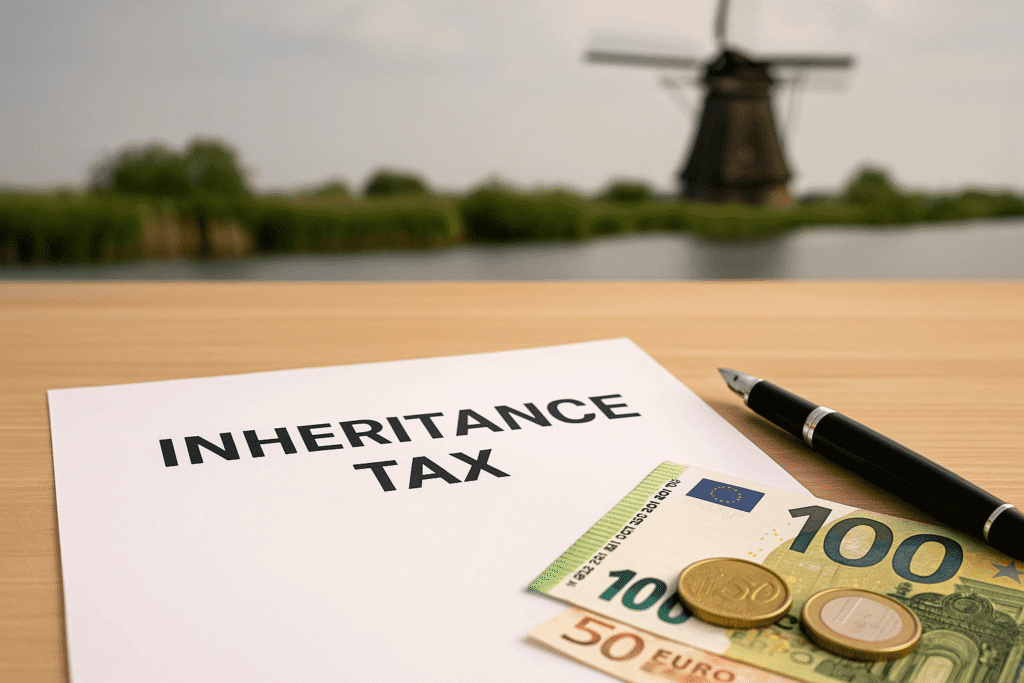
If you own assets in the Netherlands or are expected to inherit assets in this country, it’s important to understand the legal and tax implications involved.
In the Netherlands, there are complex rules for the taxation of inheritances and gifts, with significant implications for heirs of assets. An early understanding of Dutch law and early planning of wills, residency, and gifts during lifetime can significantly reduce exposure to tax payments when transferring assets between generations.
Beyond that, inheritance tax planning can prevent legal disputes, delays in the inheritance process, and unexpected demands from various authorities.
What’s the Difference Between Inheritance Tax and Estate Tax?
- Estate Tax – Imposed on the deceased’s assets before they are transferred to the heirs.
- Inheritance Tax – Applies to all assets received by the heir.
Inheritance Tax in the Netherlands
In the Netherlands, there is no estate tax, but there is an inheritance tax that applies to assets transferred to heirs after the death of a Dutch resident or someone considered a Dutch resident according to law. Dutch inheritance tax does not depend on the residency status of the heir or the location of the assets.
As long as the deceased is not a Dutch resident according to the provisions of the law, there will be no inheritance tax liability for the heirs, even if Dutch real estate is involved.
The tax rate is determined according to the family relationship between the deceased and the heir, and is derived from the fair value of the assets transferred to the heir, as follows:
- For spouses and children, the tax rate ranges from 10% to 20%. A rate of 10% applies to inheritances valued at up to 154,197 euros, and 20% for the remainder of the inheritance.
- For grandchildren and great-grandchildren, the tax rate ranges from 18% to 36%.
- For other heirs, the tax rate ranges from 30% to 40%.
Dutch law establishes tax exemptions that also depend on the relationship between the deceased and the heir. For example, spouses are entitled to an exemption of 636,180 euros, while children are entitled to an exemption of 20,148 euros. The portion exceeding the exemption amount is subject to the tax rates mentioned above.
Gift Tax in the Netherlands
Gift tax is an important part of planning for the transfer of assets between generations. Often, when property owners are exposed to the amount of inheritance tax, the option of transferring assets as gifts during the testator’s lifetime arises, with the thought that this is preferable to inheriting in the future. However, it should be taken into account that gifts may be taxable at the same or even higher rates than the inheritance tax rates.
The Dutch gift tax applies to any transfer of property without consideration, given by a person who was a Dutch resident (or considered a resident) at the time of giving the gift.
In the Netherlands, Dutch citizens are considered residents even if they have left the Netherlands for a period of ten years after emigration. In contrast, non-citizens are considered residents for gift tax purposes only for one year after departure.
Similar to inheritance tax, gift tax is also calculated according to the relationship between the gift giver and the recipient, and at identical tax rates.
Therefore, early planning for inheritance tax and gift tax is essential when transferring assets between generations. Proper planning allows you to maximize existing exemptions, significantly reduce tax liability, and ensure that assets are transferred to the next generation in an orderly and efficient manner.
Inheritance Taxation in Israel Compared to the Netherlands
In Israel, unlike the Netherlands, there is no estate tax or inheritance tax. However, in certain cases, tax may be imposed on the full value of the inheritance received, such as capital gains tax when selling the asset.
The tax treaty between Israel and the Netherlands includes provisions that can prevent double taxation. Still, it’s important to plan the reporting and filing accurately to avoid double payment.
To read the Israel-Netherlands Tax Treaty in English on the Ministry of Finance website, click here.
Making a Will in the Netherlands – The Key to Tax Savings and Dispute Prevention
Inheritance doesn’t always transfer smoothly to heirs. Sometimes complex procedural steps are needed to obtain a probate order or permission to realize the assets.
Creating an organized will is not just a matter of personal desire; it is an integral part of estate taxation. A detailed will can ensure that assets are transferred smoothly and efficiently to the heirs. The will should include the wishes of the deceased but must also be adapted to the requirements of the law so that its validity is not compromised.
When drafting a will, it is often possible to choose the law that will apply to it. This choice can have a substantial impact on inheritance planning and its future realization.
Without advance planning, meaning inheritance without a will, the law that will apply to the deceased’s assets will be the law of the deceased’s last and principal place of residence. For example, if the last place of residence is in the Netherlands, Dutch law will apply to the inheritance in Israel.
If you own assets in the Netherlands, our recommendation is to make a will to ensure that the transfer of assets is done as smoothly as possible. A will can prevent misunderstandings or lengthy legal processes and ensure that the process proceeds in an orderly manner even after the death of the deceased.
Received an Inheritance in Italy? 7 Steps for Proper Realization of Inheritance from Italy
1. Clarification of Factual and Legal Background
First, check the type of asset that is to be inherited, its location, the identity and status of the heirs, the value of the asset, and more.
2. Checking the Timing and Location of Inheritance Realization
Consider whether it’s advisable to realize the asset now, and if so, where is it better to realize it – in the Netherlands or in Israel?
3. Regulatory and Banking Aspects
It is recommended to check the costs of money transfers, whether there is a need to open an account in the Netherlands or another country for the purpose of transferring funds, what approvals are required, etc.
4. Planning the Asset Transfer
Consider whether to transfer the asset itself or its proceeds, and what the implications are in terms of tax, exemptions, deductions, etc.
5. Avoiding Double Taxation
In light of the existence of a double taxation prevention treaty, it is recommended to check whether there is a mechanism for crediting tax paid in the Netherlands against tax liability in Israel. Make sure that the reporting is done correctly and accurately to avoid double payment.
6. Checking the Future Effects on the Asset
It is recommended to examine the future effects on the asset; for example, a future sale of the asset will often be subject to capital gains tax in Israel as well.
7. Transferring the Asset to Israel
Performing all necessary actions, submitting documents, handling matters with banks in the Netherlands and Israel, and executing the asset transfer.
How Can We Help?
The goal is to transfer the inheritance to heirs in Israel in the most tax-efficient way, while addressing legal issues in Israel and the Netherlands, and issues related to banking and regulation. For example, whether it’s better to realize a certain asset in the Netherlands or transfer it to Israel; how to transfer inheritance funds to a bank account in Israel; how to use various exemptions between heirs; whether to give gifts during lifetime; whether to establish a trust, and more. Strategic planning, according to law and tax treaties, is essential to minimize tax liabilities.
Nimrod Yaron & Co. has extensive experience in personally and professionally accompanying Israelis with assets or inheritances in many countries around the world, including the Netherlands, from the first stage of planning, through dealing with authorities in the Netherlands and Israel, to transferring inheritance funds to the heir’s bank account.
We work with all relevant professional entities in the Netherlands and Israel and offer legal solutions both in terms of taxation and banking, tailored to the circumstances of the case.
If you have inherited an asset or wish to bequeath assets in the Netherlands in the future, our team of lawyers specializing in international taxation and inheritance law will be happy to advise you on this matter – contact us for an initial consultation.
Q&A
Who is subject to inheritance tax in the Netherlands?
Dutch inheritance tax applies to any person who died as a Dutch resident or was considered a Dutch resident at the time of death.
Do I need to pay tax in Israel on an inheritance from Amsterdam?
No. There is no inheritance tax in Israel. However, capital gains tax may apply after the sale of the property. It is important to check the recommended date for selling the inherited property.
Why is it important to plan the transfer of assets between generations in advance?
The transfer of assets between generations from abroad is not just a family matter but also a tax and economic issue. Early planning, considering legal issues in Israel and abroad, can save a lot of money and prevent legal complications.
How can the inheritance be realized optimally and save tax?
To realize the inheritance optimally and save unnecessary tax payments, all tax options should be examined, including utilizing exemptions, planning gifts, establishing companies, trust funds, and more.
How can the inheritance tax liability in the Netherlands be reduced?
Through early tax planning, which includes drafting a will, utilizing exemptions, giving gifts during your lifetime, and more, you can significantly reduce your tax liability.
Is it better to give an asset as a gift during lifetime or to bequeath it?
The choice between giving a gift and bequeathing depends on the circumstances of the case. Sometimes a gift will be taxed similarly to an inheritance. Therefore, the legal and tax aspects should be examined before making a decision.
What are the implications in case there is no will?
In the absence of a will, the inheritance will be divided among the legal heirs according to Dutch inheritance law.
What documents are required for the process of realizing an inheritance in the Netherlands?
To realize an inheritance in the Netherlands, documents such as a death certificate, a will (if one exists), copies of the heirs’ ID cards, property ownership documents, bank account confirmations, and more are required.
How long does the process of realizing an inheritance in the Netherlands take?
It should be considered that the process of realizing an inheritance in the Netherlands can take between several months and a year or more, depending on the complexity of the testator’s estate, the number of heirs, the existence of a will, and other factors.