
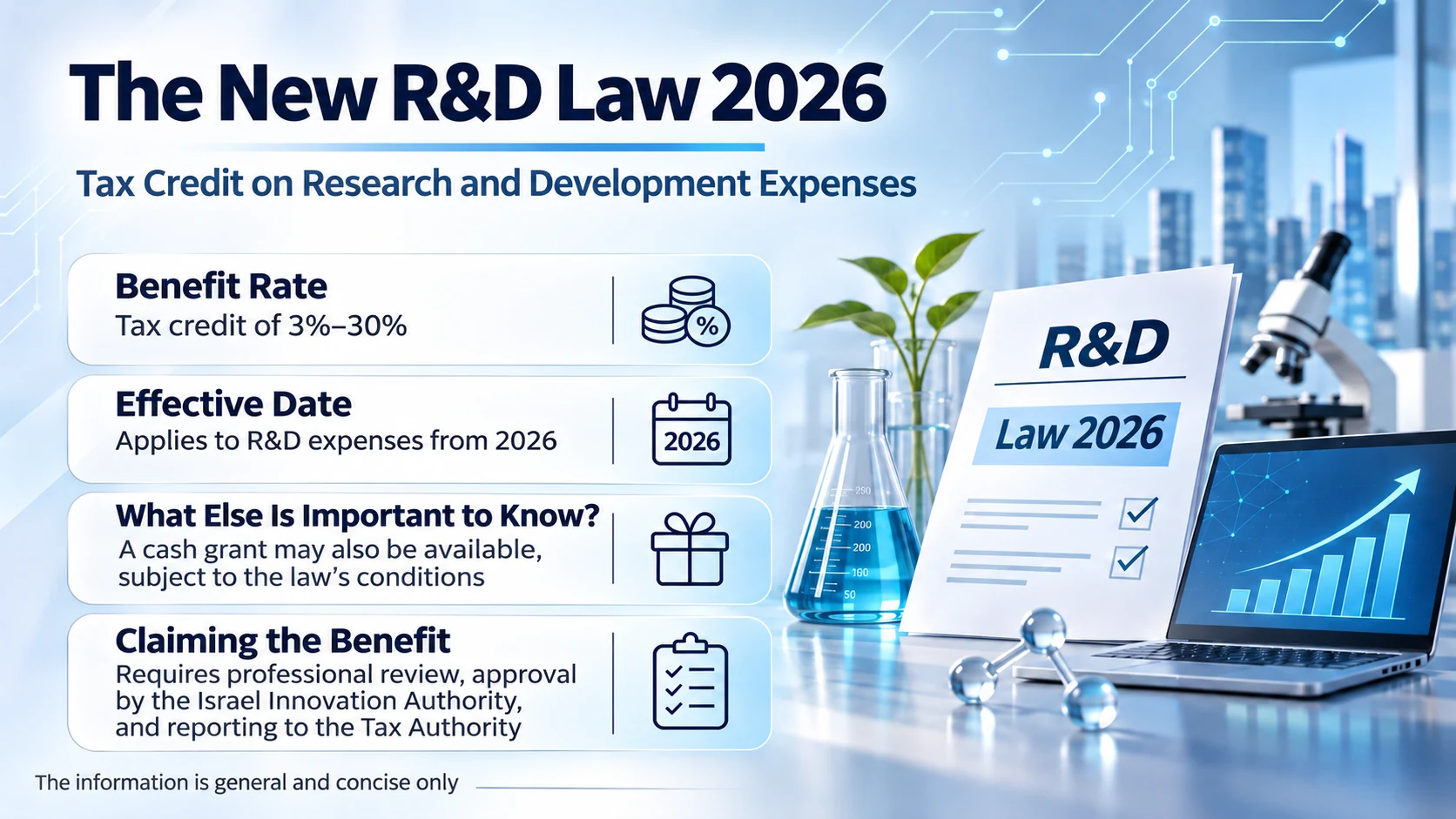
In March 2026, the Knesset approved the Law for the Encouragement and Incentivization of Research and Development, which grants companies that meet its conditions a tax credit at a rate of 3% to 30% of qualifying research and development (R&D) expenses. The law was published in the Official Gazette on March 31, 2026, and applies to R&D expenses incurred from the 2026 tax year onward.
The law is intended to encourage companies to expand their research and development activity in Israel, against the background of changes in international taxation and increasing competition among countries for investment in the technology industry.
The benefit is not intended only for high-tech companies. It may also apply to industrial enterprises that engage in research and development and meet the conditions of the law.
In addition to the tax credit, the law allows, under certain conditions, the credit to be utilized in later tax years, allocated among eligible companies in the same group, or converted into a cash grant for an unused credit. However, eligibility is subject to meeting significant threshold conditions and obtaining approval from the Israel Innovation Authority.
Why Was the Law for the Encouragement and Incentivization of Research and Development Enacted?
The law was enacted against the background of the implementation of the OECD global tax rules known as Pillar Two. These rules are intended to ensure that large multinational groups that meet the prescribed conditions are subject to a minimum effective tax rate of 15%.
Israel adopted a qualified domestic minimum tax mechanism under the Minimum Corporate Tax Law for Multinational Groups, which applies from 2026 onward.
This change may reduce the effectiveness of some traditional tax benefits that are based on reduced corporate tax rates. The new law seeks to preserve Israel’s attractiveness through an incentive based on the scope of research and development activity carried out in Israel.
Unlike a deduction, which reduces taxable income, a tax credit directly reduces the tax liability, subject to the provisions of the law. The possibility of receiving, under certain conditions, a cash grant for an unused credit may give the benefit value even when a company does not have sufficient tax liability to utilize it.
Who Is Eligible for the Tax Credit for Research and Development Expenses?
Eligibility is determined based on both the characteristics of the company and the enterprise, and the characteristics of the business group to which the company belongs.
The company must qualify as a “qualifying company” as defined in the law, belong to the same “eligible group” throughout the relevant tax year, and meet additional requirements.
For the definition of an eligible group, the law provides, among other things, the following cumulative conditions:
Scope of revenues: The revenues of the qualifying companies in the group from preferred enterprises or preferred technological enterprises must reach at least ₪100 million per year. This amount is adjusted annually according to the index.
Composition of revenues: These revenues must constitute at least 55% of the total revenues of the Israeli resident companies belonging to the group, in accordance with the calculation rules and exceptions set out in the law.
Number of employees: The qualifying companies in the group must employ at least 200 full-time employees in Israel during the tax year, or employ an average of 200 employees during the tax year and the two preceding tax years, provided that in each of the three years at least 150 employees were employed, calculated in accordance with the provisions of the law.
Classification of the company and the enterprise: The company and the enterprise must meet the relevant definitions in the new law, which are based in part on the provisions of the Law for the Encouragement of Capital Investments.
It is important to distinguish between the revenue test, which is intended to determine whether the group is an eligible group, and the classification of the enterprise, which affects, among other things, the rate of the credit.
These conditions indicate that the law is primarily intended for business groups with significant activity in Israel. A small startup, even if it invests substantial amounts in research and development, will not be eligible for the benefit if it does not meet the threshold conditions.
What Is the Tax Credit Rate for R&D Expenses?
The credit rate varies according to the type of enterprise, its location, and the amount of qualifying research and development expenses of the group.
| Up to ₪1.05 billion | Over ₪1.05 billion | Type of enterprise |
|---|---|---|
| 25% | 30% | Industrial enterprise in Development Area A |
| 25% | 30% | Special research and development enterprise |
| 3% | 4% | Research and development enterprise not in the increased benefit track |
A special research and development enterprise is an enterprise that meets the definition set out in the law, including the relevant requirements for technological activity and membership in a group whose revenues in the tax year are at least ₪10 billion. Eligibility for the increased rate under this track is not, in itself, conditional on the enterprise being located in Development Area A.
By contrast, an industrial enterprise located in Development Area A may be eligible for the increased rates even if it is not classified as a special research and development enterprise, subject to the other conditions of the law.
The ₪1.05 billion threshold is examined in relation to the total qualifying R&D expenses of all qualifying companies in the group, and not separately for each company or enterprise. Where a group has enterprises with different credit rates, the law provides a proportional mechanism for calculating the expenses above the threshold.
Which Research and Development Expenses Qualify for the Tax Credit?
The law defines the types of expenses that may be included in the credit calculation, subject to the conditions and limitations prescribed.
Employee salary costs: 100% of the recognized salary cost of employees engaged in research and development in Israel may be included. The calculation is based on the salary components specified in the law, and includes adjustments for employer contributions, National Insurance contributions, and equity-based compensation, including the exclusion of certain expenses for equity-based compensation that were not allowed as a deduction under Section 102 of the Income Tax Ordinance.
Equipment and productive assets: Recognized depreciation for equipment and productive assets used for research and development activity in Israel may be included. Under the conditions set out in the law, usage fees for productive assets that are not owned by the enterprise may also be included. Certain buildings and vehicles are excluded from the definition.
Subcontractors: As a general rule, 65% of R&D expenses incurred through unrelated subcontractors in Israel may be recognized. The law also allows, under defined conditions, the recognition of expenses paid to subcontractors outside Israel, for example for clinical trials that cannot be performed in Israel.
Related subcontractors: A special track was established for expenses incurred through an Israeli resident subcontractor that is a related party, subject to proving the qualifying expenses. Where the expenses cannot be proven, the Director of the Israel Tax Authority may approve recognition of 65% of the R&D expenses paid to the subcontractor, in accordance with the conditions of the law.
Materials and components: Expenses for components, disposable equipment, and consumable materials that were fully consumed as part of research and development activity in Israel during the tax year may be included.
Additional expenses: Additional R&D expenses in Israel that are not similar in nature to the other categories and are not rental expenses or depreciation of buildings may be recognized, up to a cap of 20% of the qualifying salary cost, in accordance with the law.
How Is the Tax Credit Obtained?
Utilizing eligibility for the tax credit requires compliance with the conditions of the law and completion of a process that includes filing an application with the Israel Innovation Authority and reporting to the Israel Tax Authority.
As part of the process, the group structure, the classification of the research and development activity, and the qualifying expenses must be examined, alongside the preparation of the required documents and reports. The deadlines prescribed by law must also be met, and the method for allocating the credit among the eligible companies in the group should be examined.
It is advisable to consult a professional who specializes in corporate taxation and investment incentive laws in order to assess eligibility, support the application process, and choose the method of utilizing the benefit that best fits the circumstances of the company and the group.
For further information, the Israel Innovation Authority’s guidelines for implementing the R&D Law 2026 may be reviewed.
Implications of the Law for Multinational Corporate Groups
The law is particularly important for multinational groups that maintain research and development centers in Israel.
First, eligibility must be examined based on the group structure, the Israeli companies, the composition of revenues, and the number of employees, and not only based on the expenses of a single Israeli company.
Second, in groups that carry out transactions between related companies, the contractual arrangements and the allocation of research and development activity and expenses among the companies must be examined.
These issues may also intersect with transfer pricing analysis and the pricing of development services provided to related companies outside Israel. In particular, it is necessary to examine how the income from the development activity in Israel is classified, and whether the company meets the relevant definitions for purposes of the benefit.
In addition, where the group is subject to the global minimum tax rules, the interaction between the credit and the qualified domestic minimum top-up tax must be examined, as well as the treatment of the benefit for international tax purposes.
The income tax treatment of the benefit should also be taken into account. Section 9 of the law provides that a credit that could have been received as a grant had it not been offset will be treated as a grant for purposes of the Income Tax Ordinance. Accordingly, the tax implications of the credit must be examined, and it should not be assumed that the stated credit rate necessarily reflects the net economic benefit rate. At the same time, Section 8 of the law provides that the benefit is not deemed part of the price of a dealer’s transactions under Section 12 of the VAT Law.
It follows that the eligibility analysis is not limited to calculating the credit rate. It requires an examination of the credit’s effect on the overall tax liability and on the group’s operating structure.
In summary, the Law for the Encouragement and Incentivization of Research and Development of 2026 creates a new mechanism of tax credits and grants for companies that carry out significant research and development activity in Israel.
The credit rates, which may reach up to 30% of qualifying R&D expenses under certain conditions, may provide a significant economic advantage to companies and business groups that meet the conditions of the law.
However, utilization of the benefit requires a preliminary review of the eligibility conditions, the classification of the expenses and the enterprise, the group-level implications, and the approval process with the Israel Innovation Authority and the Israel Tax Authority.
Nimrod Yaron & Co. specializes in Israeli and international taxation, including tax planning for high-tech companies and startups, implementation of the Law for the Encouragement of Capital Investments, and taxation of multinational corporate groups. You may contact us to assess the implications of the law and eligibility for the tax benefits based on the circumstances of the company and the group.
Frequently Asked Questions
Is every high-tech company eligible for a tax credit for research and development expenses?
No. Eligibility is subject to conditions relating to the scope of revenues, the composition of revenues, the number of employees, the classification of the company and the enterprise, and membership in an eligible group. The mere existence of research and development activity is not sufficient.
Does the benefit also apply to industrial companies that are not high-tech companies?
Yes. The law may also apply to industrial enterprises that conduct research and development activity, subject to the eligibility conditions. An industrial enterprise in Development Area A may benefit from the increased credit rates.
Can a company with no profits or no tax liability benefit from the incentive?
Yes, under certain conditions. The law allows an unused credit to be carried forward to later tax years, or a cash grant to be received in accordance with the mechanism and deadlines prescribed. However, a company that does not meet the eligibility conditions will not be able to receive the benefit solely because it conducts R&D activity.
Is an Israeli development company that provides services to a related company outside Israel eligible for the benefit?
This depends on the characteristics of the activity, the classification of the income, and the eligibility conditions of the company and the group. Among other things, it is necessary to examine whether the income from the development activity meets the relevant definitions under the law, as well as the pricing and reporting of the transactions between the related companies.
Can a credit also be obtained for research and development expenses incurred outside Israel?
As a general rule, the benefit focuses on research and development activity in Israel. However, the law allows certain expenses incurred through subcontractors outside Israel to be recognized.
Is approval from the Israel Innovation Authority required?
Yes. Obtaining approval for the classification of the expenses as qualifying R&D expenses is part of the eligibility conditions. The approval does not, in itself, guarantee that the company meets all other conditions of the law, which are also examined as part of the reporting and assessment processes with the Israel Tax Authority.
When can the money for 2026 R&D expenses be received?
Under the income tax track, the credit may generally be utilized from 2028 onward. Under the qualified domestic minimum tax track, utilization may be requested already with respect to 2026, subject to the conditions of the law. Under the cash grant track, an application may be filed in 2030. The payment date is subject to the provisions of the law and the processing of the application.
Can the benefit be received in addition to other government grants?
Possibly. However, in calculating the qualifying expenses, grants received for research and development expenses must generally be deducted, except for the exceptions set out in the law. Therefore, the full range of grants and benefits received by the company should be examined in order to calculate the credit correctly.