
What are hybrid entities, how is a U.S. LLC taxed in Israel, and what are the implications for double taxation, foreign tax credits, and tax treaties?
Taxation of Hybrid Entities: How Do Differences Between Countries Affect Tax Liability?
In the world of international taxation, the same company may be treated as a separate entity in one country and as a transparent entity for tax purposes in another. This gap lies at the core of the taxation of hybrid entities, and it may lead to double taxation, difficulties in obtaining foreign tax credits, and in some cases, tax advantages arising from differences between tax systems.
For Israeli investors holding foreign companies, and for international corporate groups, understanding the tax classification of the entity is essential for proper planning of the activity and for avoiding unexpected tax exposures.
What Is a Hybrid Entity?
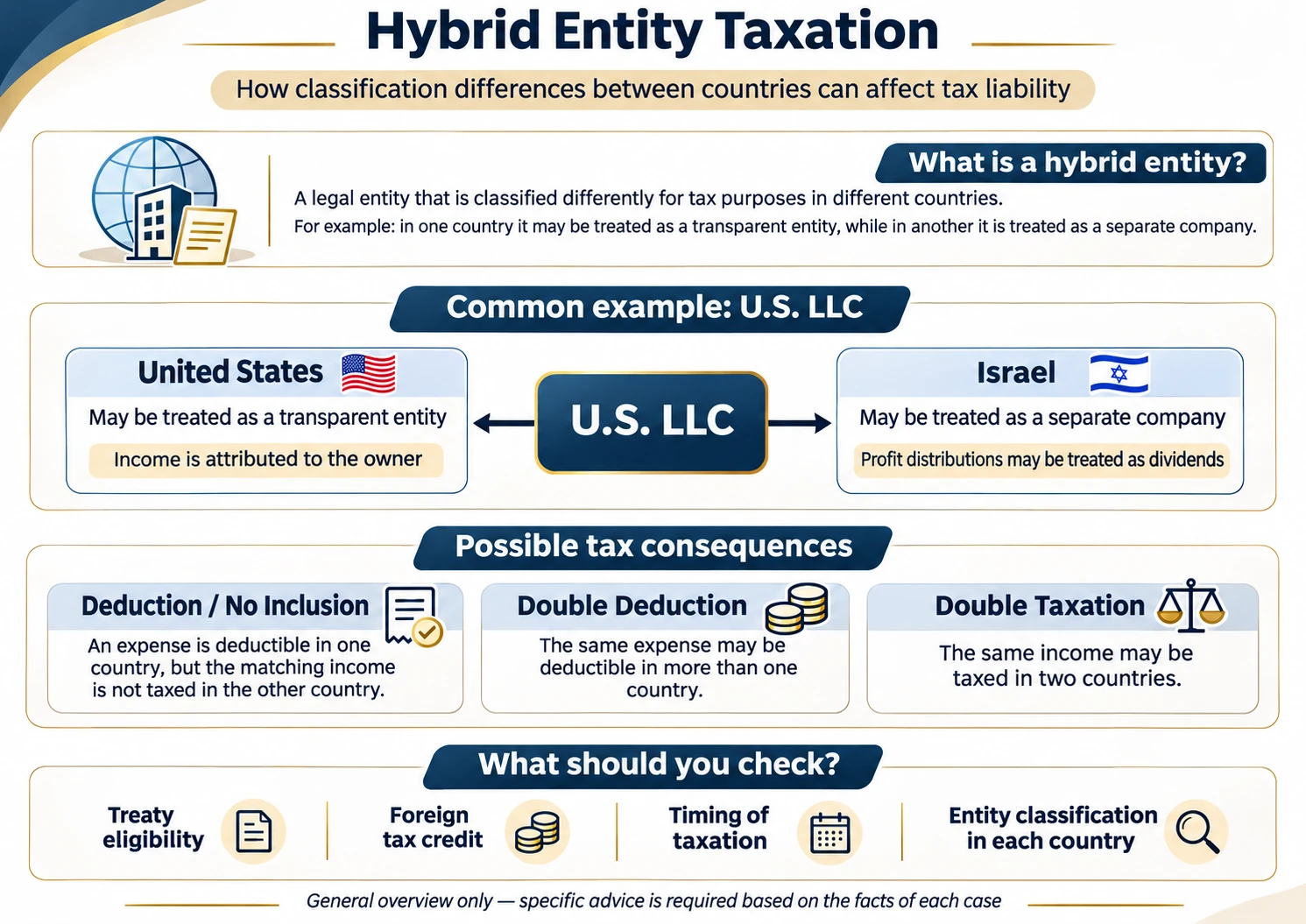
A hybrid entity is a legal entity that different countries classify differently for tax purposes. Usually, this involves a difference between two types of classification:
- Transparent entity: the entity’s income is attributed directly to its equity holders, and they are required to pay tax on it even if the profits are not actually distributed.
- Opaque entity: the entity is treated as a separate taxpayer, and the equity holders may become liable for additional tax when profits are distributed.
A common example is a U.S. limited liability company (LLC), which may be treated as transparent for U.S. tax purposes, while in Israel it is classified as a separate body of persons.
The difference in classification may create a situation in which the equity holder pays tax in the United States on the company’s profits, but in Israel becomes liable to tax when they are distributed as a dividend, without an automatic ability to credit the U.S. tax already paid.
It is important to distinguish between legal classification and tax classification. A company may provide its owners with limited liability from a legal perspective, while being treated as transparent for tax purposes. In addition, the mere fact that an entity is defined as transparent in one country does not require another country to recognize it as such.
What Tax Implications May Arise?
Differences in the classification of entities and financial instruments between countries may create three main outcomes:
- Double taxation – the same income is taxed in two countries, without an appropriate foreign tax credit.
- Double deduction – the same expense may be recognized for tax purposes in more than one country.
- Deduction without corresponding taxation – an expense is recognized in one country, while the corresponding income is not included in the tax base in the other country.
The implications are not limited to the tax rate. The entity’s classification also affects the identity of the taxpayer, the timing of the tax liability, the ability to offset losses, and the manner in which transfers of funds to the equity holders are taxed.
For example, an investor may hold an income-producing asset through a transparent entity in a foreign country and become liable to tax on the rental income each year. If Israel treats the entity as a separate company, a timing mismatch may arise between the tax liability abroad and the tax liability in Israel.
To address tax planning based on these differences, the Organization for Economic Co-operation and Development (OECD) published the Action 2 recommendations as part of the Base Erosion and Profit Shifting (BEPS) project.
Following these recommendations, various countries adopted rules designed to prevent the exploitation of hybrid mismatches. In the European Union, for example, rules under the Anti-Tax Avoidance Directive 2 (ATAD 2) apply in order to neutralize certain tax advantages arising from classification differences.
How Are Hybrid Entities Taxed in Israel?
Israeli law does not automatically adopt the tax classification assigned to an entity in the country in which it was incorporated. The classification is determined under Israeli law, based on the entity’s characteristics and the tax provisions applicable to it.
A key example is the treatment of U.S. LLCs. Under Income Tax Circulars 3/2002 and 5/2004, an LLC may be treated as a body of persons for Israeli tax purposes, even if in the United States its income is attributed directly to the equity holders.
However, Income Tax Circular 5/2004 allows, under certain conditions, an Israeli resident holding an out-of-Israel transparent U.S. LLC to report the entity’s income in Israel on a current basis and receive a credit for the foreign tax paid on that income.
Practical Example: An Israeli Resident Holding a U.S. LLC
Assume that an Israeli resident holds a U.S. LLC that invests in real estate in the United States. During the year, the company generates profits from rental properties, but does not distribute them to its owners.
In the United States, if the LLC is classified as a transparent entity, the income is attributed to the equity holder, who may become liable to tax on it even without a distribution of profits. In Israel, by contrast, the company may be treated as a separate entity, and therefore the mere generation of profits by the company does not necessarily create taxable income for the Israeli holder.
When the profits are distributed in the future, tax liability may arise in Israel as a dividend, without the ability to receive a credit for the U.S. tax paid earlier.
In appropriate circumstances, applying the arrangement under Circular 5/2004 makes it possible to report the income in Israel on a current basis, receive a foreign tax credit subject to the limitations under the law, and avoid additional tax on the distribution of profits that have already been reported and taxed under the arrangement.
It is important to emphasize that the arrangement does not make the LLC a transparent entity for all purposes in Israel. In particular, it does not allow the entity’s losses to be offset against other income of the holder, or allow personal exemptions and special individual tax rates to apply solely by virtue of the attribution of the income.
In addition, if the control and management of the LLC’s business are exercised in Israel, the company may be considered an Israeli tax resident. In such a case, a different tax analysis is required, because the entity itself may become liable to tax in Israel.
For further reading, see our article on corporate tax residence and the control and management test.
What Is a Reverse Hybrid Entity?
Alongside regular hybrid entities, there are also reverse hybrid entities. These are entities that the country of incorporation treats as transparent for tax purposes, while the country of residence of the equity holders classifies them as separate entities.
In certain circumstances, this difference may lead to a situation in which the country of incorporation does not tax the entity because the income is attributed to its owners, while the country of the equity holders does not tax the income on a current basis because it treats the entity as a separate company.
The possible result is tax deferral or non-taxation in both countries. Hybrid mismatch rules are intended to address these situations as well, among other things by imposing tax on the entity or denying tax benefits created by the classification mismatch, in accordance with the provisions of local law.
Taxation of Hybrid Entities and International Tax Planning
The issue of hybrid entities does not arise only in investments by individuals. It is also relevant to international corporate groups that enter into financing transactions, hold subsidiaries, or conduct business activity in several countries.
For example, when a company in one country provides financing to a related company in another country, a difference may arise in the classification of the payment: one country may view it as deductible interest, while the other country may classify it as a dividend that may be exempt from tax.
This is a case of a hybrid financial instrument, as distinct from a hybrid entity, but both phenomena fall within the international rules for preventing mismatches.
The rules adopted in different countries may result in the denial of the expense deduction or the inclusion of the income in the tax base. Therefore, a structure that previously created a tax advantage does not necessarily achieve the same result today.
How Do Tax Treaties Affect Hybrid Entities?
When an entity is classified differently in two countries, the question of eligibility for benefits under a tax treaty may also arise.
Certain provisions in tax treaties, including provisions derived from the Multilateral Instrument (MLI), regulate the application of treaty benefits to income derived through transparent entities.
Under these provisions, in appropriate cases it is necessary to examine whether the income is treated as the income of a resident of one of the countries for its tax purposes. This means that incorporation in a treaty country does not always in itself confer entitlement to treaty benefits. The manner in which the income is taxed at the level of the entity or its owners must also be examined.
The application of these provisions depends on the wording of the specific tax treaty and on any changes that apply to it, to the extent applicable, under the MLI.
What Should Be Reviewed Before Establishing a Hybrid Entity?
Before establishing a company or investing through a foreign entity, it is important to examine its tax classification in each of the relevant countries, the timing of the tax liability, the ability to receive a credit for foreign tax, and the implications of profit distributions.
It is also necessary to review the application of tax treaties, the ability to offset losses, and the international tax provisions that may apply to the structure, including controlled foreign company (CFC) rules, foreign professional company rules, and the control and management test.
In addition, Israeli reporting obligations with respect to holdings in foreign companies must be taken into account, and in appropriate cases, the need to report their income as well.
This review is especially important when dealing with a new activity, an expansion of activity into an additional country, or a change to an existing holding structure. Advance planning may prevent double taxation, reduce exposures, and help select the holding structure that best suits the nature of the activity.
For more information on the considerations involved in choosing an operating structure abroad, see our article on establishing a company abroad.
International Taxation – Professional Support from Nimrod Yaron & Co.
The taxation of hybrid entities requires an integrated review of the tax laws in the various countries and the way they are applied in Israel.
Nimrod Yaron & Co. specializes in Israeli and international taxation and advises individuals, investors, and companies on matters involving the taxation of foreign companies, foreign tax credits, and the planning of international holding structures.
Do you hold a foreign company or plan to conduct international business activity?
Contact us to review the tax implications and the appropriate structure for your activity
Frequently Asked Questions
Is every U.S. LLC a hybrid entity?
No. An LLC may be classified in the United States as a transparent entity or elect to be taxed as a corporation. An entity is considered hybrid when there is a relevant difference between its classification in different countries.
Can a credit be obtained in Israel for tax paid in the United States on LLC income?
Yes, under certain conditions. Income Tax Circular 5/2004 allows an arrangement for attributing the income of the LLC to the Israeli equity holder for the purpose of obtaining a foreign tax credit, subject to the provisions of the circular and the credit limitations.
Can losses of a U.S. LLC be offset in Israel?
As a rule, the arrangement under Circular 5/2004 does not allow the losses of the LLC to be attributed to the holder for the purpose of offsetting them against the holder’s other income in Israel.
Can using a hybrid entity reduce tax?
Not necessarily. Hybrid structures may create tax advantages in certain circumstances, but they may also lead to double taxation and the denial of deductions. The result depends on the laws of the relevant countries, the tax treaties, and the provisions aimed at preventing tax planning.
Can a tax treaty solve the double taxation problem in a hybrid entity?
Sometimes, but not always. It is necessary to examine the wording of the treaty, the classification of the entity in each country, and the identity of the taxpayer liable to tax. Certain classification differences require further review of domestic law provisions and foreign tax credit mechanisms.