
Electronic invoices, real-time reporting and changing tax requirements: what Israeli companies operating abroad need to know
Israeli companies operating abroad must deal with different VAT requirements in each country. Filing a periodic return is only one part of the picture. In many countries, companies must also issue electronic invoices, report transactions shortly after they are carried out and retain documents in accordance with local rules. These requirements affect the company’s day-to-day operations, from sales and procurement to accounting and information systems. To comply with them, companies need to understand what is required in each country and adapt their work processes accordingly, not only their software.
When a company operates in several countries, it must understand that a process that is suitable for one country does not necessarily meet the requirements of another. Reporting obligations may vary according to the type of transaction, the identity of the parties, the place of activity and its scope. To manage these obligations consistently, a company needs a clear picture of the local requirements, together with a central ability to collect data, perform controls and monitor filings and deadlines.
What Is Changing in VAT Reporting Abroad in 2026
The trend toward digital reporting is gaining momentum in 2026-2028, with the phased entry into force of new obligations relating to electronic invoicing and transaction data reporting. In France, phased implementation is scheduled to begin in September 2026, distinguishing between the obligation to receive electronic invoices and the obligations to issue invoices and report data, depending on the size of the business and the type of transaction. In Germany, the obligation to issue electronic invoices is scheduled to be introduced in stages from January 2027 through January 2028, subject to the applicable conditions, turnover thresholds and transitional provisions. Implementation and expansion processes are also underway in Poland and Greece during the 2026-2028 period.
At the European Union level, the VAT in the Digital Age (ViDA) package includes a transition to digital reporting based on electronic invoices for cross-border business-to-business (B2B) transactions within the European Union, with an effective date set for July 1, 2030. Alongside local reforms, this change reinforces the need for systems capable of issuing, receiving, validating, storing and transmitting invoice data in the required formats.
Under the traditional model, VAT reporting was based mainly on collecting data at the end of the reporting period, making adjustments and filing a return.
Under digital models, some of the information is required already when the invoice is issued or within a short period after the transaction. These reports do not necessarily replace the periodic VAT return and may be added to it. This means that it is not always possible to wait until the period is closed in order to identify errors and address them.
Some of these control mechanisms are known as Continuous Transaction Controls, or CTC. They allow the tax authority to receive transaction data on an ongoing basis and, in certain models, require the invoice or its data to be submitted to a designated platform for approval or reporting. The scope of the obligation varies between countries and may include business-to-business (B2B) transactions, business-to-consumer (B2C) transactions or business-to-government (B2G) transactions, as well as credit notes, receipts and transport documents.
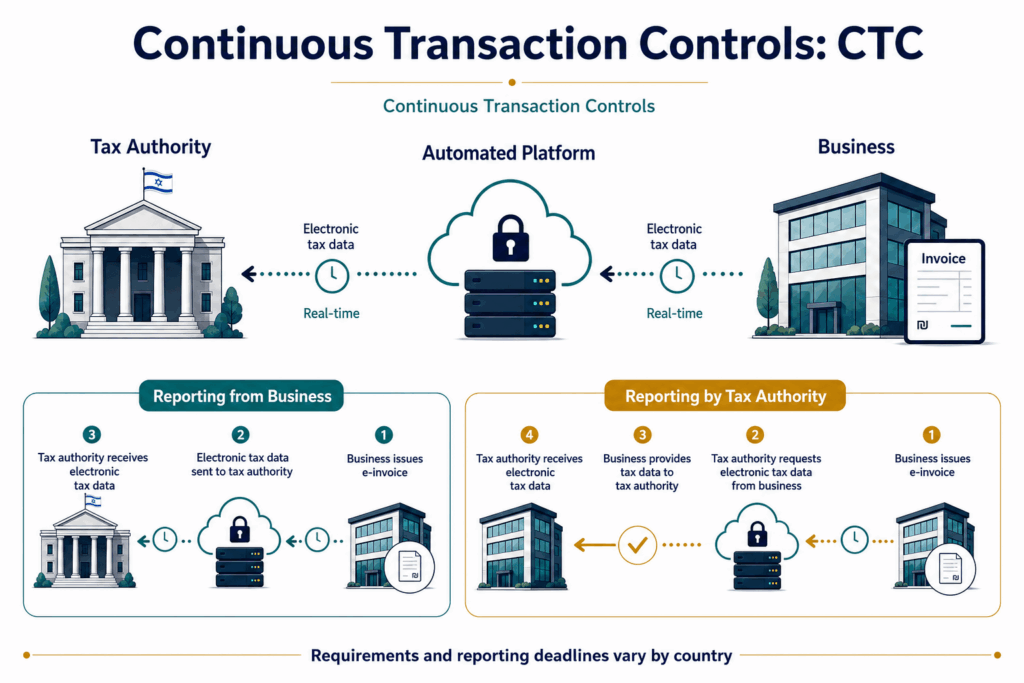
When reporting is carried out close to the time of the transaction, data quality becomes critical from the outset. Among other things, companies must verify the identity of the parties, tax identification numbers, transaction classification, place of supply, VAT rate, date, currency and document number. Missing data or incorrect coding may lead to rejection of a document or report, operational delays or tax exposure, depending on the local framework.
Local Requirements, Centralized VAT Management
Even where a common framework exists, such as in the European Union, reporting obligations are not uniform across all countries. In addition to periodic VAT returns, companies may be required to file intra-Community transaction listings, Intrastat statistical reports, accounting data files such as Standard Audit File for Tax (SAF-T), and invoice or transaction reports. Not every obligation applies to every company, and it is important to distinguish between tax reports and other related obligations.
Examples of the variety of models include invoice reporting in Hungary, the myDATA system in Greece, Immediate Supply of Information (SII) reporting in Spain and electronic invoicing systems in Latin American countries.
Global VAT management requires a combination of local knowledge and centralized control. The local function must understand the law, the formats and the interface with the tax authority. Group management must know who is responsible for each report, when it is required, whether it has been filed and whether it has been accepted. A clear allocation of responsibilities is especially important when handling is split among subsidiaries, the finance team, external advisers and technology providers.
Data Quality: The Basis for Proper Reporting
Correctly calculating the VAT amount is necessary, but it is not enough. Even a transaction that has been treated correctly from a tax perspective may encounter reporting difficulties if mandatory fields are missing, if the tax identification number is invalid or if the data does not conform to the local format. Data accuracy must therefore be reviewed alongside the substantive VAT treatment.
This data may be located in enterprise resource planning (ERP) systems, invoicing systems, sales and procurement systems, e-commerce platforms, logistics systems and local systems of subsidiaries. When data is split between systems, gaps may arise between the company’s financial information and the data reported to the tax authorities.
Technology Alongside International VAT Advice
Technology helps with data collection, document conversion, information transmission, archiving and monitoring filings. However, it does not replace international VAT advice. Each transaction may raise substantive questions: what is the correct VAT treatment, whether there is a right to deduct or recover input tax, whether a registration obligation arises, how a complex transaction should be reported and what the tax implications are of a change in the operating model.
Professional advice is also needed to translate tax conclusions into system work rules: how to classify transactions, which tax codes to define, when exceptional treatment is required and which documents must be retained. The connection between tax expertise, local knowledge and technology helps reduce manual work and improve reporting consistency, but it requires updates when the law or the business activity changes.
Looking Ahead: The Value of Integrated Tax Advice
The shift to electronic invoices, real-time VAT reporting and digital reporting to tax authorities is expected to continue affecting the operations of international companies. Proper preparation does not end with adapting a system to a new reporting format. It requires ongoing review of the business activity and the related tax obligations.
International VAT management does not stand alone. The group structure, the allocation of functions among the companies, intercompany agreements and transfer pricing policies may also affect the analysis of VAT obligations and reporting. A technological solution alone is therefore not enough. An integrated view of the international tax framework is required, alongside a separate review of the VAT treatment based on the characteristics of the transactions and the law in each country.
The value of professional support lies in connecting the group’s business picture with the tax requirements and practical implementation. An early review can help identify exposures, map registration and reporting obligations and define the appropriate treatment of transactions, before selecting a system or implementing a new process. This can reduce the risk of gaps between the operating structure, agreements, invoices and data transmitted to the tax authorities, and help build an infrastructure that will also support expansion into additional countries.
An integrated response brings together advice on the group structure, the setting of transfer pricing policies and the review of VAT and indirect tax implications, together with digital solutions for managing reporting and compliance obligations. This combination makes it possible to translate tax conclusions into work processes and system requirements, while maintaining a centralized view of the group’s activity and alignment with local rules.
Nimrod Yaron & Co. specializes in Israeli and international taxation. Our team is composed of professionals with many years of experience at the Israel Tax Authority, as well as experience at leading firms and law offices, bringing together legal and economic perspectives. We advise private and public companies, Israeli and foreign companies, global venture capital funds, and clients seeking focused advice in clear and accessible language. We also work with a professional network of accounting firms and law firms around the world, in order to provide comprehensive support in cross-border matters.
Does your company operate abroad or expand into new markets? We assist with reviewing VAT registration and reporting obligations, preparing for electronic invoicing and integrating local tax requirements with the group structure and transfer pricing policies. Alongside our advisory services, we assist in connecting companies with a suitable digital platform, to link the tax conclusions with the work processes and reporting in practice.
FAQ
Is an Israeli company required to register for VAT abroad?
Not necessarily. The obligation depends on the country of activity, the type of transactions, the place of supply and the local rules. It should be reviewed before starting or changing the activity.
Is it necessary to file VAT returns abroad even when reporting in Israel?
Possibly. Reporting in Israel does not replace reporting obligations in another country. The obligations arising from the activity in each country should be reviewed separately.
What is the difference between an electronic invoice and a PDF invoice?
An electronic invoice is sometimes required in a structured data format suitable for automated processing. A regular PDF file does not necessarily meet the electronic invoicing requirements in the relevant country.
What is real-time VAT reporting?
This is a mechanism for transmitting invoice or transaction data to the tax authority when the transaction is carried out or shortly thereafter, in accordance with the deadlines and conditions set in the relevant country.
Does digital reporting replace the periodic VAT return?
Not necessarily. In different countries, digital reporting is added to the periodic return. Adjustments and controls are therefore required between the transaction data and the returns filed with the authority.
Can the Israeli invoicing system be used abroad as well?
Only if it supports the local requirements. Formats, mandatory fields, data transmission, approvals and document retention must be reviewed in each country in which the company operates.
Does an invoice without tax authority approval allow input tax deduction?
The answer depends on the local law and the type of approval required. There is no uniform rule, and the deduction conditions, exceptions and correction options in the relevant country should be reviewed.
How should companies prepare for digital VAT reporting abroad?
By mapping the countries and transactions, reviewing obligations and deadlines, adapting systems and data, defining responsibilities and controls, and testing the process before it goes live and on an ongoing basis.
What is the connection between transfer pricing and international VAT?
Transactions between related companies and transfer pricing adjustments may raise VAT questions. The implications are reviewed based on the substance of the transaction and the local law, and not automatically.