
What should be examined in loans between related parties, how an arm's length interest rate is determined, and what can be learned from the recent court ruling on the subject
When one company in a group grants a loan to a related company, the question arises: what interest rate should be set?
As a general matter, there is of course no single interest rate that is right for every loan. However, when the transaction is an international transaction between related parties, the interest rate must be examined in accordance with transfer pricing rules and reflect the terms that would have been agreed between unrelated parties.
To determine whether the loan is made on arm’s length terms, it is not enough to examine only the interest rate. The loan term, currency, collateral, the borrower’s risk profile, repayment terms and the overall financing structure may all affect whether the loan was made on arm’s length terms.
A recent ruling by the District Court, which examined interest of 10%-12% on loans between companies compared with bank financing at interest rates of 2.8%-4.4%, illustrates how important it is to substantiate the interest rate and transaction structure in advance.
Is a loan between related companies always considered a transfer pricing transaction?
Section 85A of the Income Tax Ordinance [New Version] addresses international transactions between parties with special relationships and provides that the terms of the transaction must be examined by reference to the terms that would have been agreed between unrelated parties.
Transfer pricing rules do not apply only to the sale of products or the provision of services. Financing, credit and loan transactions between related companies may also fall within their scope.
The key question is what terms an unrelated lender and borrower would have agreed between them if they had entered into the same transaction on arm’s length terms.
This is the arm’s length principle, which is at the core of transfer pricing rules in Israel and worldwide.
Therefore, the mere fact that two companies belong to the same group does not allow them to set any interest rate they choose between them
How is interest between related companies determined?
One of the common mistakes is to look for a single interest rate that can be applied to every loan between related companies. In practice, an arm’s length interest rate is determined according to the specific characteristics of the loan and of the parties to the transaction.
Among other things, the following should be examined:
- The loan amount
- The currency in which it was granted
- The loan term
- The borrower’s financial condition
- The borrower’s risk level
- The purpose of the financing
- The existence or absence of collateral
- Guarantees provided by other companies in the group
- The priority of the debt in relation to other liabilities
- The repayment schedule and repayment terms
- The interest rates at which the borrower could have obtained financing from an external party
- Similar financing transactions entered into between unrelated parties
For example, a long-term loan, without collateral, to a borrower with high credit risk may justify a higher interest rate than a short-term loan backed by high-quality collateral. The fact that a certain interest rate seems “reasonable” to you is not enough. You need to be able to explain, through an economic rationale, why it is appropriate for the specific transaction being examined.
How is an interest rate benchmarking analysis performed in transfer pricing?
As part of an interest rate benchmarking analysis, market data and transactions are examined in order to identify comparables for the loan between the related companies. In some cases, an internal comparable may be available. For example, if the same company took out a loan from a bank or an unrelated financing provider during the same period, it may be possible to examine whether that loan can serve as a point of comparison.
However, comparing interest rates alone is not sufficient. A bank loan secured by an asset is not necessarily comparable to an unsecured loan from a group company. The loan term, currency, repayment terms, credit rating and date of the transaction can also have a significant impact on the interest rate.
If there is no suitable internal comparable, a market analysis must be performed to identify external financing transactions with similar characteristics. The result will be a range of reasonable arm’s length interest rates, rather than a single absolute interest rate.
Why does the loan structure matter, and not only the interest rate?
A transfer pricing review of financing transactions does not stop at the question of whether the interest rate is 5%, 8% or 10%. In some cases, the way in which the financing is structured must also be examined.
When funds move from one company to another, then to a third company, and finally reach the company that needs the financing, the question may arise as to why all the links in the chain were needed and what the economic role of each of them was.
In such structures, it is advisable to be able to explain:
- Why the financing was provided specifically in this way
- What the economic role of each company in the chain was
- What risk each company assumes
- Whether that company actually makes decisions regarding the financing
- And what alternative was available to the parties
The more complex the financing structure, the greater the importance of documenting the commercial and economic rationale behind it.
The ruling: interest of 10%-12% versus bank interest of 2.8%-4.4%
In the ruling in Tax Appeal 61448-06-24, issued on August 13, 2026, the court discussed, among other things, a chain of loans in which an Israeli family company received loans totaling approximately ₪53 million from a company resident in Belize.
The loans bore interest of 10%-12% and were granted without collateral. At the same time, the same company also received financing from banking corporations abroad at interest rates of 2.8%-4.4%. The source of the funds loaned by the Belize company was a family holding company, which provided it with funds at an interest rate of 10.5%.
This created a chain in which the money moved from the holding company, through the foreign company, to the Israeli company.
The court identified several cumulative difficulties in the structure. Among other things, it was not sufficiently explained why the holding company did not provide the financing directly to the family company, and difficulties arose with respect to the loan documentation and the commercial justification for the chosen structure.
The structure also had tax significance: the Israeli company sought to deduct financing expenses at a high rate, while at the other end of the financing chain a tax advantage was created.
The gap examined in the ruling
Comparison between the interest on the intercompany loans and the interest on the bank financing
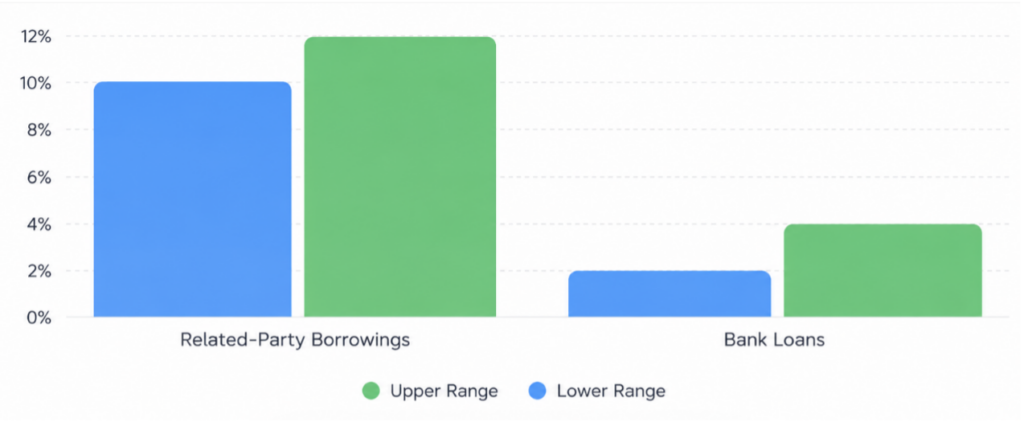
The gap between the interest rates was one of the elements examined in the ruling. However, the gap in itself does not prove that the interest rate is not at arm’s length. The question is whether it can be explained and substantiated in accordance with the characteristics of the loan.
Does the fact that the loan was unsecured justify a higher interest rate?
This is one of the interesting points in the ruling. The company argued that the loan it received from the foreign company should not be compared directly with the bank loans. The reason was that the bank loans were backed by collateral, while the loan from the foreign company was granted without collateral.
In principle, the absence of collateral increases the lender’s risk and may therefore justify a higher interest rate. The court acknowledged that the comparison between the types of financing was not perfect. However, the company did not present an alternative comparable that could be used to determine the appropriate interest rate for a loan with similar characteristics.
In the absence of a benchmark, the position of the assessing officer was accepted, and the financing expenses were limited according to the bank interest rates.
The case illustrates an important point:
It is not enough to say that the loan is riskier and therefore the interest rate is higher. The interest rate gap must also be substantiated through data and economic analysis
The interest rate analysis should preferably be performed before the loan is granted
The practical conclusion from the ruling is much broader than the specific case. When a company in a group grants a loan to a related company abroad, it is not advisable to rely only on a loan agreement that states an interest rate that seems logical to the parties.
Already at the transaction structuring stage, it is advisable to examine the arm’s length interest rate range, which transactions are suitable as comparables, how risk and collateral affect the pricing, whether the financing structure can be explained from an economic perspective, what role each company plays in the transaction, and what documentation will need to be presented in the event of an audit.
Documentation is no less important. Depending on the circumstances, it is recommended to retain loan agreements, interest rate analyses, comparable data, management resolutions, collateral documents and documentation of the business considerations behind the financing structure.
Transfer pricing in financing transactions is not relevant only to large corporations
Financing transactions between related parties also exist in private groups, family companies, Israeli companies establishing operations abroad, and among business owners who hold companies in several countries.
In these cases in particular, the loan may arise naturally: one company needs funds, and another company in the group has surplus cash. Only at a later stage does it become clear that the transfer of funds created an international transaction that may be subject to transfer pricing rules.
Therefore, before providing financing between related companies, and certainly where significant amounts are involved or the structure includes several countries, it is advisable to examine both the transaction structure and the interest rate in advance. Appropriate planning and documentation in advance may significantly reduce future disputes with the tax authorities and provide a professional basis for defending the transaction terms in the event of an audit.
Nimrod Yaron & Co. specializes in Israeli and international taxation. Our team is composed of professionals with years of experience at the Israel Tax Authority, as well as experience at leading firms and law offices, bringing together both legal and economic perspectives.
We advise private and public companies, Israeli and foreign companies, global venture capital funds, and clients seeking focused advice in clear, accessible language. We also work with a professional network of accounting firms and law offices around the world in order to provide comprehensive support in cross-border matters.
When it comes to loans between related companies, determining the interest rate, analyzing arm’s length terms and transfer pricing documentation, it is highly recommended to examine the transaction terms in advance and not wait for a tax audit.
In our international transfer pricing department, we assist with reviewing the financing structure, determining an appropriate interest rate range, analyzing comparable transactions, documenting the economic rationale of the transaction, and preparing for the requirements of the tax authorities in each country. We perform full transfer pricing research studies tailored to the characteristics of the transaction and to the requirements of the relevant law and practice.
Frequently Asked Questions
Is a loan between related companies considered a transfer pricing transaction?
Yes. An international transaction between related parties may be examined under the arm’s length principle, including the loan terms and the interest rate.
How is a market interest rate between related companies determined?
The loan term, currency, risk, collateral, repayment terms and similar transactions between unrelated parties are examined.
Can the interest rate paid by the company to a bank be used as a comparison?
Sometimes yes, but only if the loan terms are similar in terms of collateral, term, currency, risk and repayment terms.
What happens if the Israel Tax Authority determines that the interest rate is too high?
The Israel Tax Authority may make a transfer pricing adjustment and reduce the interest expenses permitted as a deduction for tax purposes.
What documents should be retained in connection with the loan?
A loan agreement, interest rate analysis, comparable data, management approvals, collateral documents and documentation of the commercial rationale.
Are the rules also relevant to private and family companies?
Yes. Transfer pricing rules may also apply to private groups, family companies and businesses operating in several countries.
Is only the interest rate examined?
No. The financing structure, flow of funds, roles of the parties and economic rationale of the transaction are also examined.