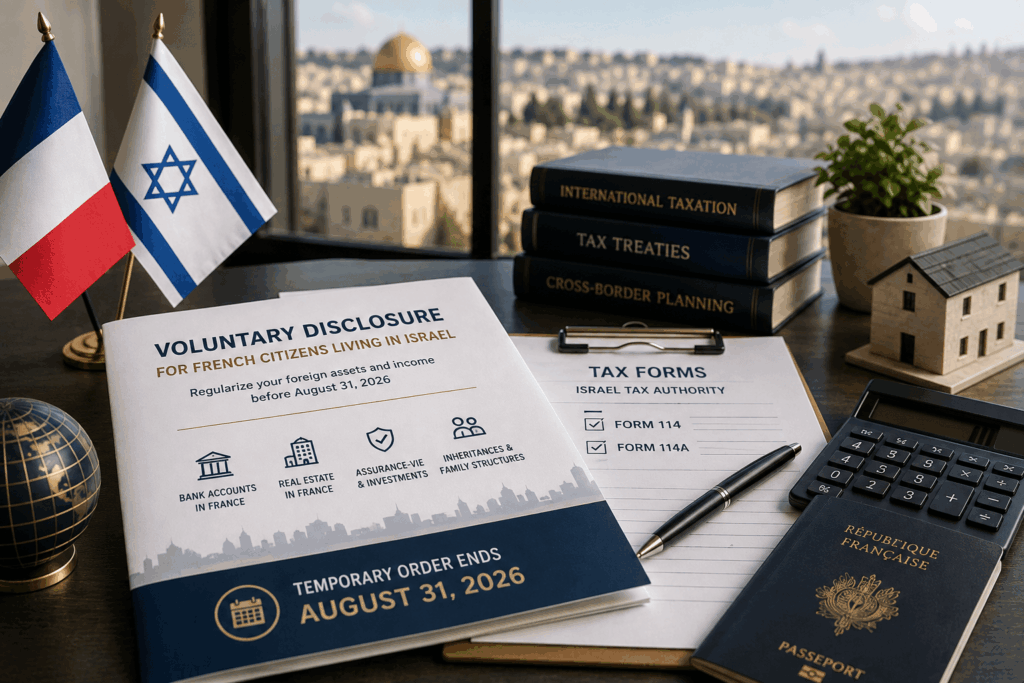
Many French citizens living in Israel still hold bank accounts in France, rental real estate, assurance-vie policies, investment portfolios, inheritances, or family structures. As international transparency increases, the voluntary disclosure procedure may help close past reporting gaps before an audit begins.
For many French citizens who have chosen to make Israel their home, life is lived along a delicate line between two countries. Israel has become the center of life: work, family, children serving in the IDF or studying at university. France, meanwhile, often remains in the background – with an old bank account, perhaps a rental property, an investment portfolio, an inheritance, or a family structure established years ago.
Most of the time, that gap is barely felt. But in recent years, largely beneath the radar, the rules of the game have changed. Not overnight, and not through one dramatic headline, but through a series of small, cumulative regulatory steps. And when it comes to taxation, small steps can lead to significant consequences.
An Era in Which the Authorities No Longer “Discover by Chance”
The global financial system has undergone a quiet revolution. Automatic exchange of information mechanisms between countries – including the Common Reporting Standard (CRS) and other international frameworks – have made financial opacity increasingly unrealistic. Information about bank accounts, investments, and assets now flows between countries even without any proactive action by the taxpayer.
In addition, in recent years the Israel Tax Authority has significantly expanded its ability to cross-check information from local sources as well – including land registry data, banking activity, and economic ties developed over time. The practical result is clear: gaps that once went unnoticed are now far more visible.
What Is the Voluntary Disclosure Procedure – and Why Does It Exist?
Israel’s voluntary disclosure procedure is a framework that allows taxpayers to proactively disclose income and assets that were not properly reported in the past.
The principle is simple: a taxpayer who approaches the authorities before the authorities approach them, provides a full and truthful disclosure, and pays the applicable tax may receive criminal immunity in respect of past tax offenses.
It is a legal tool designed to address a complex reality in which individuals have operated for years across different countries, tax systems, and legal cultures, without always fully understanding what Israeli law required of them at the time. However, there is one critical limitation: once a tax audit has begun, or once the Israel Tax Authority already holds concrete information regarding the taxpayer, the door to voluntary disclosure may close.
Why Is This Particularly Relevant for New Immigrants?
New immigrants benefit from a significant Israeli tax incentive: a ten-year exemption from reporting and paying Israeli tax on foreign-source income. It is a broad benefit, but also one that often creates confusion.
Many new immigrants interpret this exemption as absolute protection for any income that has a foreign connection. In practice, the picture is more nuanced. Israeli-source income remains fully reportable and taxable even during the exemption period; foreign companies effectively managed and controlled from Israel may be subject to tax and reporting obligations in Israel; and trusts, inheritances, family companies, and cross-border family structures may trigger reporting obligations even during the exemption years.
The real issue often emerges only in hindsight. At the end of the ten-year period, many immigrants discover that no comprehensive review was ever conducted for the earlier years. This leaves a gap that is difficult to close without a proactive disclosure process.
But Not Only New Immigrants – Long-Time Residents Should Also Pay Attention
A common misconception is that voluntary disclosure is relevant only to new immigrants, especially after their exemption period ends. In practice, a significant portion of inquiries comes from French citizens who have lived in Israel for decades.
These are individuals who were never aware that rental income from a property in France required reporting in Israel, who left French bank accounts, investment accounts, or assurance-vie policies running “on autopilot,” or who are connected to family assets in France, inheritances, family companies, or cross-border structures – without realizing that this status may have Israeli tax implications.
In most cases, this is not deliberate tax evasion. It is a knowledge gap – between what is customary in French tax and banking practice and what Israeli law requires.
Trusts and Inheritances
For many French families, intergenerational planning often includes inheritances, gifts, family companies, or life insurance structures such as assurance-vie policies.
In Israel, by contrast, cross-border family wealth structures – including trusts, where relevant – are among the most complex and sensitive areas of tax law.
A connection to a foreign trust or a cross-border family structure, even without receiving any actual distributions, may trigger reporting obligations in Israel. When such reporting has not been made for years, often due to lack of awareness, real legal and tax exposure may arise.
When the Issue Reaches the Bank
What once seemed theoretical has become very practical. Israeli banks now operate as strict gatekeepers, requiring clear documentation regarding the source of funds and confirmation that the applicable taxes have been properly paid. Without an orderly tax regularization process, funds originating from inheritances, family structures, trusts, or accounts abroad may be blocked from transfer to Israel, delay transactions, or in some cases even lead to frozen banking activity.
Where Professional Guidance Becomes Critical
One of the key features of the voluntary disclosure procedure is that it may be used only once in a lifetime. There is no room for error: a partial disclosure, an inaccurate factual presentation, or failure to collect the required documents may permanently close the door to the procedure.
Beyond the procedural risks, the way the disclosure is structured and presented may have a material impact on the overall tax outcome. Certain factual characterizations, legal positions, and treaty-based arguments may significantly reduce the tax assessed, while an unstructured or overly simplistic presentation may lead to a far less favorable result.
In such cases, practical experience is crucial. We are among Israel’s leading firms in the field of voluntary disclosure procedures, advising clients on complex matters involving international assets, income, and structures – with a deep understanding of how the Israel Tax Authority works, how the banking system operates, and the sensitivities involved in cross-border cases.
In addition, in France-related cases, the Israeli process may need to be coordinated with French tax reporting, French banking documentation, and local advisers. Managing the Israeli and French aspects together enables a synchronized and optimized approach and significantly reduces the risk of unintended exposure.
In conclusion, whether you are a new immigrant approaching the end of your exemption period or a French citizen who has lived in Israel for many years, if you hold assets, accounts, family structures, trusts, inheritances, or income outside Israel, a proactive review and regularization may make the difference between long-term certainty and unnecessary complications.
For many people, the voluntary disclosure procedure is not about sophisticated tax planning. It is about closing historical gaps, removing uncertainty, and continuing life in Israel without lingering question marks.
As a reminder: the temporary order for voluntary disclosure ends on 31.08.2026, and August 2026 is the final month for submission.
Nimrod Yaron & Co. specializes in Israeli and international taxation. Our team is made up of professionals with years of experience at the Israel Tax Authority, alongside experience at leading firms and law offices, bringing together both legal and economic perspectives. We advise private and public companies, Israeli and foreign companies, global venture capital funds, and clients seeking focused advice in clear and practical language. We also work with a professional network of accounting firms and law offices around the world, allowing us to provide comprehensive support in cross-border matters.
If you have a connection to France – a bank account, property, inheritance, assurance-vie policy, trust, family company, or income that has not been properly reviewed in Israel – now is the time to conduct a discreet and precise review of the potential exposure and available regularization options. In appropriate cases, an early review and proper management of the process may reduce exposure, prevent mistakes, and help achieve an optimal outcome.
FAQ
What is the voluntary disclosure procedure?
It is a procedure that allows a taxpayer to proactively report previously unreported income or assets, pay the required tax, and, in appropriate cases, receive criminal immunity.
Who should consider applying for the procedure?
Anyone who holds assets, income, accounts, inheritances, or legal structures outside Israel, and is concerned that they may not have fully complied with Israeli reporting obligations.
Can new immigrants also need a review?
Yes. Despite the tax benefits granted to new immigrants, some situations may still involve reporting obligations or tax implications, especially complex structures or income connected to Israel.
What happens if the Israel Tax Authority has already contacted me?
In general, if an audit has already begun or the Israel Tax Authority has concrete information about you, the option to submit a voluntary disclosure may be blocked or become significantly more complicated.
Why is professional guidance important?
Because the presentation of facts, document collection, international coordination, and management of the process with the Israel Tax Authority and banks may materially affect the risk, process, and tax outcome.