
The Israel Tax Authority’s voluntary disclosure procedure ended on August 31, 2026, after a year in which taxpayers were given an opportunity to report previously unreported income and capital, pay the applicable tax, and avoid criminal proceedings for the tax offenses covered by the procedure, subject to meeting its conditions.
According to data published by the Israel Tax Authority, only 823 applications were submitted under the procedure, declaring capital of approximately ₪1.89 billion. The estimated principal tax in respect of these applications is approximately ₪152.6 million. This is relatively low compared with the cumulative results of previous procedures. One possible reason is the cancellation of the option to submit an anonymous application.
The key question today is not what the results of the procedure were, but what can be expected for those who did not use it and still hold income or assets that were not duly reported to the Israel Tax Authority
Is it still possible to amend tax returns and settle tax liabilities? Can a voluntary report prevent criminal proceedings? How does the Israel Tax Authority currently identify foreign income and profits from digital currencies? And what is the significance of the crypto investigations that were revealed shortly after the procedure ended?
In this article, we examine the implications of the end of the voluntary disclosure procedure, the civil and criminal risks, and the options that remain available to taxpayers who wish to regularize their reporting.
The Voluntary Disclosure Procedure Has Ended – What Has Changed?
The 2025 voluntary disclosure procedure was published on August 25, 2025 as a temporary order, with the approval of the Attorney General, and remained in effect until August 31, 2026.
Its purpose was to allow taxpayers who had not reported income or capital as required by law to correct their reporting, pay the applicable taxes, and avoid criminal proceedings for the tax offenses covered by the procedure, in accordance with its conditions.
The procedure applied to all tax areas, including income tax, value added tax (VAT), customs, and real estate taxation, and allowed identified applications only.
One of the main conditions was that the disclosure had to be made voluntarily by the taxpayer, honestly, in good faith, and in full, before any relevant audit or investigation had begun, and subject to the additional conditions regarding information already held by the authorities.
With the end of the procedure, the option to submit a new application under the temporary order expired. As of October 2026, no new voluntary disclosure procedure has been published, and no extension of the procedure that ended has been announced.
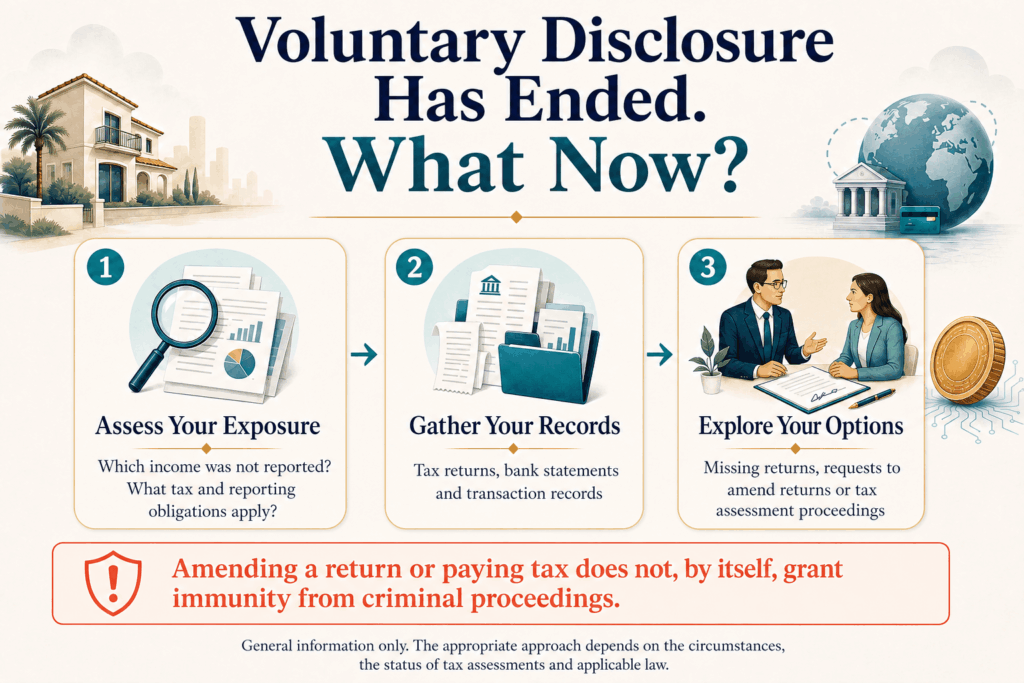
It is important for us to emphasize that the end of the voluntary disclosure procedure does not cancel reporting and tax payment obligations, and does not necessarily preclude the possibility of regularizing missing reports. However, without the procedure, merely filing an amended report or paying tax does not provide immunity from criminal proceedings.
This distinction is particularly significant for those who have avoided reporting for several years, carried out complex activity in foreign accounts, or hold assets from which the income was not reported in Israel.
Results of the 2025-2026 Voluntary Disclosure Procedure
In a notice published by the Israel Tax Authority on September 7, 2026, it was reported that throughout the procedure period, 823 voluntary disclosure applications were submitted, reporting total capital of approximately ₪1.89 billion. The estimated principal tax in respect of the applications is approximately ₪152.6 million.
Approximately half of the applications were submitted during August 2026, the final month in which it was possible to apply under the procedure.
In Which Areas Were Most Applications Submitted?
Estimated Principal Tax | Scope of Reported Capital | Number of Applications | Reporting Area |
₪32.3 million | ₪358.2 million | 324 | Rental income |
₪51 million | ₪482.5 million | 203 | Digital assets (crypto) |
₪41.9 million | ₪623.1 million | 197 | Foreign bank accounts |
Alongside these areas, applications were also submitted in relation to capital gains, business income, inheritances, diamonds, and additional matters.
Why Was the Response Relatively Low?
According to Israel Tax Authority publications, under the three previous procedures, which operated in the years 2011-2012, 2014-2016, and 2017-2019, approximately 9,000 cases were handled and tax totaling approximately ₪5 billion was collected.
Compared with these cumulative figures, the results of the latest procedure indicate a relatively limited response. At the same time, differences in the duration of the procedures, their terms, and the populations they addressed should be taken into account.
Several factors may explain the low response:
Cancellation of the anonymous track – Unlike some previous procedures, the latest procedure required applicants to disclose their identity when the application was submitted. This may have deterred taxpayers who were concerned about the consequences of the application being rejected or about the possibility that the information they provided would be used in the circumstances specified in the procedure.
Concern about criminal exposure – Even when the purpose of the approach is to regularize tax liabilities, taxpayers may be concerned about the consequences of the information they provide, especially where complex activity or missing reports over many years are involved.
Complexity of reporting digital assets – Crypto activity may include hundreds or even thousands of transactions, transfers between wallets, exchanges between currencies, and activity on various platforms. It is sometimes difficult to reconstruct the acquisition cost and the taxable gains.
Difficulties in the banking system – Holders of crypto gains may encounter difficulties transferring funds originating from the realization of digital assets to bank accounts in Israel, due to requirements relating to identifying the source of funds and preventing money laundering.
The question that remains open is how the Israel Tax Authority will act toward those who did not submit applications during the period
What Is the Risk for Those Who Did Not Report Income?
Failure to report income, or underreporting income to the Israel Tax Authority, may create exposure in both the civil and criminal arenas. However, there is an important distinction between a reporting error, failure to comply with a reporting obligation, and intentional tax evasion.
Civil Exposure: Tax, Interest, Linkage Differentials, and Penalties
When it becomes clear that taxable income was not reported, the Israel Tax Authority may act to determine the tax liability in accordance with its powers under law. The possible consequences include payment of the tax that was not paid on time, linkage differentials and interest, penalties, and additional civil sanctions, depending on the circumstances.
In appropriate cases, the consequences may be significant even where the funds themselves were accumulated many years ago. A distinction should also be made between cases in which no return was filed despite an obligation to file one, and cases in which a return was filed but certain income was omitted from it.
Criminal Exposure: When Can Non-Reporting Be Considered a Tax Offense?
The Income Tax Ordinance establishes various offenses relating to failure to file returns, providing incorrect information, and evading tax payment.
Section 220 of the Income Tax Ordinance deals, among other things, with acts committed willfully and with intent to evade tax, such as omitting income from a return, providing false details, or using fraud, deceit, or trickery. These offenses may lead to criminal proceedings, fines, and even prison sentences.
However, not every instance of non-reporting or every error in a return necessarily indicates an intention to evade tax.
The distinction between a good-faith mistake and intentional conduct depends on the circumstances of the case, the evidence, the taxpayer’s conduct, and the elements of the relevant offense.
The Crypto Investigations Revealed in October 2026
The end of the voluntary disclosure procedure took place at a time when the tax authorities’ capabilities to identify, collect, and cross-check information are continuing to develop.
A prominent example can be found in the investigations published in October 2026 regarding digital currency activity. It was recently reported that, as part of a joint investigation by the Israel Tax Authority and the Israel Police, a resident of northern Israel was arrested on suspicion of committing tax and money laundering offenses connected to digital currency trading activity on a scale of tens of millions of dollars.
According to the published suspicions, the activity was conducted through various crypto exchanges, without being reported as required to the Israel Tax Authority. Additional suspicions were raised regarding the holding of foreign bank accounts and the use of another person’s bank account to conceal activity and funds.
As part of the investigation, significant amounts of foreign currency and a luxury vehicle that was allegedly registered in another person’s name were reportedly seized.
Another Investigation: Information Received from Binance
On the same day, the Israel Tax Authority published a notice regarding another investigation, centered on an Ashdod resident suspected of failing to report digital currency activity.
According to the Authority’s notice, as part of the investigation, identification documents were received from Binance that linked the suspect to an account in which trading activity of approximately $13 million was carried out during the years 2019-2021, using wallets he owned.
How Can the Israel Tax Authority Identify Foreign Income and Assets?
In recent years, the options available to tax authorities for obtaining information on international financial activity have expanded.
Israel participates in international information exchange arrangements, including the Foreign Account Tax Compliance Act (FATCA) with the United States and the Common Reporting Standard (CRS), which is the standard for automatic exchange of information on financial accounts between participating jurisdictions.
These arrangements allow relevant financial information to be transferred between tax authorities, in accordance with the provisions of the law, the terms of the agreements, and the applicable reporting mechanisms. In addition, information may reach the authorities through investigations, cooperation between enforcement authorities, requests to financial institutions, and other sources of information.
In the crypto sector, although activity is sometimes conducted without the involvement of a traditional banking system, information about transactions may be stored on blockchains, at trading exchanges, with financial service providers, and in additional systems.
Can Unreported Capital and Income Still Be Regularized After the End of the Voluntary Disclosure Procedure?
This is the key question for taxpayers who did not use the procedure.
The answer is that even after its end, taxpayers may still have options for correcting reports and regularizing tax liabilities. However, this is handled under the regular legal framework, and not under a procedure that provides the criminal protection offered by the voluntary disclosure procedure. The appropriate path depends on the circumstances of the case and the status of the reports and assessments.
Filing Missing Returns
Where a taxpayer was required to file returns for certain tax years but did not do so, it is possible to examine the option of filing the missing returns and reporting the taxable income in them.
The process requires reviewing the reporting obligations that applied in each year, reconstructing data, calculating the taxable income and the required tax, and examining the consequences of filing returns late.
Amending Returns That Have Already Been Filed
Where returns were filed but income was omitted from them, or incorrect data was included in them, it is possible to examine the option of applying to the Israel Tax Authority to amend the reports. The ability to amend a return, the manner in which the application will be handled, and the need for approval from the Israel Tax Authority depend on the status of the return and assessment, the relevant deadlines, and the applicable legal provisions.
Accordingly, an amendment of a return should not be viewed as an automatic right in every situation, especially where a final assessment has already been issued or statutory deadlines have passed.
Regularizing Tax Liabilities as Part of Assessment Proceedings
In certain cases, it is possible to consider a voluntary approach to the Israel Tax Authority for the purpose of clarifying and regularizing the tax liability.
Depending on the circumstances, the process may include submitting data, clarifying professional disputes, assessment discussions, and reaching agreements regarding the tax liability.
Which Types of Income and Assets May Create Exposure to the Israel Tax Authority?
Not every unreported asset is necessarily an asset that was subject to a reporting obligation, and not every receipt is taxable. In order to assess the exposure, it is necessary to distinguish between the source of the funds, the ownership of the asset itself, the income generated from it, and the reporting obligations that actually applied.
Rental Income in Israel and Abroad
Property owners may be subject to tax and reporting obligations in respect of rental income, depending on the type of property, its location, the amount of income, and the relevant tax track.
In Israel, there are various tax arrangements for income from the rental of residential apartments, including an exemption under certain conditions and a 10% tax track under Section 122 of the Income Tax Ordinance. Different rules apply to foreign apartments, including provisions regarding the taxation of rental income from outside Israel, possible tax tracks, and foreign tax credits, depending on the selected track and the provisions of the law.
It is important to distinguish between the tax liability and the obligation to file a return. There are cases in which the income is exempt from tax, or in which reporting and payment are made through a designated track, but this does not provide a sweeping exemption from every possible reporting obligation.
Foreign Bank Accounts and Investments
Israeli residents may hold bank accounts and financial assets abroad. Holding them is not, in itself, a tax offense.
However, an Israeli resident is generally liable to tax in Israel on worldwide income, subject to the provisions of the law, tax treaties, and the applicable exemptions and benefits. Therefore, interest, dividends, capital gains, and other income generated in foreign accounts may be subject to tax and reporting in Israel, even if they were not transferred to an Israeli bank account.
Digital Currencies and Crypto
According to the position of the Israel Tax Authority, digital currencies are generally considered an asset for tax purposes, and not a currency for the purpose of their classification under the Income Tax Ordinance. The realization of digital assets may create a tax event, including the sale of a digital currency for money or its exchange for another digital currency.
In the case of a private investor, the gain may be classified as a capital gain. Where the activity amounts to a business, other tax provisions may apply.
Even where the activity was carried out through a private digital wallet or a foreign platform, the reporting and tax obligations applicable in Israel should be examined.
Income from Businesses, Companies, and Foreign Trusts
Business activity outside Israel, holdings in foreign companies, dividend distributions, trusts, and international financial arrangements may raise complex tax and reporting questions.
Among other things, it is necessary to examine the residency status of the rights holders, the place where the income was produced, the classification of the company or trust, special international tax provisions, and the application of double tax treaties.
In these cases, regularizing non-reporting may sometimes require an examination of several tax years and even several countries.
Inheritances and Gifts Originating Abroad
Israel currently does not impose inheritance tax or estate tax, and receiving an inheritance is generally not taxable income for income tax purposes. However, assets received by inheritance may generate taxable income, such as interest, dividends, rental income, or gains from the realization of assets.
In addition, reporting obligations may apply in Israel due to the holding of assets or receipt of funds from abroad, and tax liabilities may also apply in other countries depending on the location of the asset and local tax laws.
“Voluntary Disclosure” for Crypto
Alongside the end of the voluntary disclosure procedure, it is important to be familiar with another arrangement that applies in the field of digital currencies.
On August 31, 2026, the Israel Tax Authority announced the extension of the temporary procedure for receiving tax payments due to gains from the realization of decentralized means of payment, until December 31, 2027.
This procedure is intended to address cases in which an individual generated gains from the realization of digital currencies and wishes to pay the applicable tax, but the Israeli banking system refuses to accept funds originating from that activity. In cases that meet the conditions of the arrangement, it is possible to request to transfer the tax funds directly to the Israel Tax Authority’s account at the Bank of Israel.
The application is submitted using Form 909, together with documents and supporting materials, including information on the source of the funds used to purchase the currencies, documentation of wallet activity and transactions, and confirmation that a commercial bank in Israel refused to accept the funds.
The arrangement is intended for individuals who meet its conditions, and allows the approved tax amount, in shekels, to be transferred to the Israel Tax Authority’s designated account. It should be taken into account that the procedure includes significant conditions regarding documentation, payment approval, and tax refunds, and these should be reviewed before submitting the application.
This procedure is not a substitute for the voluntary disclosure procedure and does not, in itself, provide immunity from criminal proceedings.
Its purpose is to enable the transfer of tax funds where there is a banking difficulty, and not to provide criminal protection for previous non-reporting.
In conclusion, the end of the voluntary disclosure procedure in August 2026 marks a significant change for taxpayers who hold income or assets that were not reported to the Israel Tax Authority as required.
During the procedure period, there was an opportunity to regularize tax liabilities under special conditions, which also included protection from criminal proceedings for the tax offenses covered by the procedure. This option is no longer available to those who did not apply on time.
At the same time, developments in international information exchange, the ability to identify financial activity, and the investigations recently published illustrate that the likelihood of identifying unreported income is not limited to activity conducted through bank accounts in Israel.
However, this does not mean that every instance of non-reporting leads to a criminal proceeding, or that it is no longer possible to regularize a tax liability. Even after the end of the procedure, various courses of action may still be available, depending on the circumstances and the legal position.
The key difference is that today, a more careful and case-specific examination of the available regularization options and their accompanying implications is required.
Therefore, in cases where unreported income is discovered, or where there is doubt regarding reporting obligations, it is important to conduct a professional review of the exposure and the available options before taking steps vis-à-vis the Israel Tax Authority.
How Can We Help?
Nimrod Yaron & Co. specializes in Israeli and international taxation and assists individuals, business owners, and companies in dealing with complex tax matters, including income and assets outside Israel, reporting obligations, assessment proceedings, and the regularization of tax liabilities.
The firm’s team combines professionals with experience at the Israel Tax Authority, together with expertise in international taxation and the legal and economic aspects of tax law.
In cases of missing reports or possible exposure to the Israel Tax Authority, we assist in reviewing the facts, mapping the liabilities and risks, and examining the appropriate courses of action, while taking into account the circumstances of each case.
Do you hold income or assets that were not reported in the past? It is recommended to seek professional advice to review your tax and reporting obligations and examine the options available to you.
Frequently Asked Questions
Is a New Voluntary Disclosure Procedure Expected in 2027?
As of October 2026, no official notice has been published regarding the opening of a new voluntary disclosure procedure in 2027. The Israel Tax Authority has operated several procedures in the past, but there is no certainty that another procedure will be published or that its terms will be similar to those of the latest procedure. Therefore, this future possibility should not be relied on as a guaranteed solution.
Can an Amended Return Be Filed After the End of the Voluntary Disclosure Procedure?
It is possible to examine an application to amend a return in accordance with the circumstances and the provisions of the law. The ability to make the amendment depends, among other things, on the status of the assessment, the relevant deadlines, and the applicable conditions. Amending the return does not, in itself, provide immunity from criminal proceedings.
Does Voluntary Reporting of Unreported Income Prevent a Criminal Proceeding?
Not necessarily. Voluntary reporting and correction of omissions may be relevant circumstances in examining the case, but they do not guarantee avoidance of an investigation or criminal proceeding. The matter should be examined according to the facts and the law.
Can the Israel Tax Authority Discover a Foreign Bank Account or Crypto Account?
Yes. The Israel Tax Authority has various sources of information, including international financial information exchanges, cooperation with other authorities, and investigative tools. In the crypto sector, it is possible in certain cases to trace activity using blockchain data and information received from trading platforms and financial institutions.
This does not mean that every account or wallet is automatically reported to the Israel Tax Authority. However, it should not be assumed that activity outside Israel cannot be detected.
Can Income from Ten Years Ago or More Be Regularized?
Possibly, but this requires an examination of the circumstances of the case. The relevant limitation provisions, the status of the returns and assessments, reporting obligations, and possible criminal exposure should be examined. The mere passage of time is not enough to determine that the income is no longer relevant for tax purposes.
Is Everyone Who Holds Funds or Assets Abroad Required to Disclose or Report Them?
No. The mere holding of assets abroad does not indicate a tax offense, and not every receipt of money from abroad is taxable income. Tax and reporting obligations depend on residency status, the source of the funds, the type of asset, the income generated from it, and the other applicable legal provisions.
What Happens If I Have Already Submitted a Voluntary Disclosure Application and It Is Still Being Processed?
Applications submitted during the procedure period continue to be examined in accordance with the provisions that apply to them. It is important to check the status of the application, complete documents where required, and comply with reporting and payment deadlines, since receiving the protections is conditional on meeting the relevant conditions.