
The United Kingdom is currently promoting a new annual reporting obligation for international transactions between related parties. The change may be relevant to Israeli groups with companies or permanent establishments in the United Kingdom, and requires an assessment of the applicability of the rules and preparation for collecting the required data. The reporting obligation is expected to begin in January 2027.
At the center of the change is the International Controlled Transactions Schedule (ICTS): a structured annual report designed to enable His Majesty’s Revenue and Customs (HMRC) to identify related-party transactions where there is a concern that the current pricing is not consistent with market terms and may reduce taxable profits in the United Kingdom.
The main change concerns the reporting process and risk assessment, rather than replacing the arm’s length principle. This principle requires related-party transactions to be priced in accordance with the terms that would have been agreed between independent parties in similar circumstances.
When preparing the report, the data included in the form should be consistent with the relevant transfer pricing study for the tax years under review, the intercompany agreements, and the actual activity. Preparation should therefore also include a review of the professional basis for the pricing and the consistency of the reported information.
Why is the United Kingdom promoting this reporting obligation now?
The stated purpose is to ensure that multinational groups pay tax on profits arising from economic activity in the United Kingdom, and to focus reviews on related-party transactions where there is a concern that the pricing is not consistent with market terms and may reduce taxable profits in the United Kingdom.
The ICTS is intended to provide HMRC with information in a uniform format for automated risk assessment, alongside human review, before a tax audit is opened. The measure is expected to help HMRC carry out more focused and shorter reviews, and reduce unnecessary audits.
The measure is part of the broader development of data analysis tools and artificial intelligence, which can make it easier to cross-check large volumes of information and identify anomalies, inconsistencies, and patterns that require review. Structured and uniform reporting provides a basis for using such tools, although the ICTS policy paper does not expressly refer to the use of artificial intelligence.
In Israel as well, data cross-checking and advanced tools help the Israel Tax Authority identify reporting gaps, as we explained in our article on identifying unreported rental income. For taxpayers, this highlights the growing importance of accurate and consistent information. In the field of transfer pricing, particular care should be taken to ensure consistency between the reported data, intercompany agreements, accounting records, and the transfer pricing study.
The new reporting requirement should not be viewed as a substitute for a transfer pricing study or existing documentation, such as a Local File and Master File. These are tools with different but related purposes: the structured report helps the tax authority identify risks, while transfer pricing documentation explains and supports the pricing selected. The information appearing in them should be consistent, and any differences should be explained and documented.
Who may be subject to the reporting obligation?
The policy paper identifies three main groups of businesses that may be affected, to the extent they have relevant cross-border transactions or activities:
- UK resident businesses that fall within the scope of the transfer pricing rules.
- UK resident businesses with a permanent establishment outside the United Kingdom.
- Foreign businesses with a permanent establishment in the United Kingdom.
For an Israeli group, the analysis begins with identifying the company or activity to which the UK rules may apply. For example, a UK subsidiary that carries out transactions with its Israeli parent company may need to assess whether the regime applies.
However, the mere existence of business activity in the United Kingdom or transactions with a UK company is not sufficient to determine that a reporting obligation exists. The relevant entity, type of activity, transactions, and applicable exemptions must be reviewed.
Small and medium-sized enterprises
UK transfer pricing rules include an exemption for small and medium-sized enterprises, subject to conditions and exceptions. It should not be assumed that a company is entitled to the exemption simply because it has a small number of employees or a low local turnover.
Assessing eligibility may require consideration of the number of employees, turnover, and balance sheet total, as well as the data of associated or partner enterprises. Therefore, especially in an international group, the relevant definitions should be reviewed, and reliance should not be placed on the data of the UK company alone.
It is also important to distinguish between the exemption from the transfer pricing rules, documentation and record-keeping obligations, and the reporting obligation under the ICTS. Eligibility for the exemption and its implications for the new reporting requirement should be assessed under the applicable rules. Activity through a permanent establishment also requires a review of the relevant profit attribution rules.
What is expected to be required under the ICTS?
The main change is the submission of factual information on relevant international related-party transactions in a uniform manner, enabling the tax authority to compare and review data efficiently.
As part of the preparation process, it is recommended to identify where the data is held regarding the related parties, the types and volumes of transactions, the agreements, and the transfer pricing documentation. The next step is to align the information-gathering process with the actual reporting requirements and review its consistency with the transfer pricing study.
The connection between the ICTS form and the transfer pricing study
Preparing the ICTS form is not simply a matter of copying data from the accounting system. The reported data should be consistent with the relevant transfer pricing study, the intercompany agreements, and the actual activity. In particular, consistency should be checked in the description of the transactions, the pricing methods, the financial data, and the profitability indicators, to the extent they are required in the report.
Before completing the form, it is important to check whether an up-to-date transfer pricing study exists, which entities and periods it covers, whether it covers the transactions being reported, and whether the data in it corresponds to the accounting records for the reporting period.
Consistency does not mean that every figure must appear identically in every document. Differences may arise, for example, from different periods, the way data is presented, or adjustments made for the purpose of the analysis. However, the differences should be understood, confirmed as justified, and the connection between the data should be documented. Information should not be changed merely to create an artificial alignment between the form and the study.
If the study is not up to date or does not cover all relevant transactions, the need to update or supplement it should be considered before the report is filed. If no study exists, the documentation obligations and the need to prepare one should be reviewed.
The objective is for the form, the study, the agreements, and the accounting data to present a consistent, well-supported, and explainable picture of the transactions between the related parties.
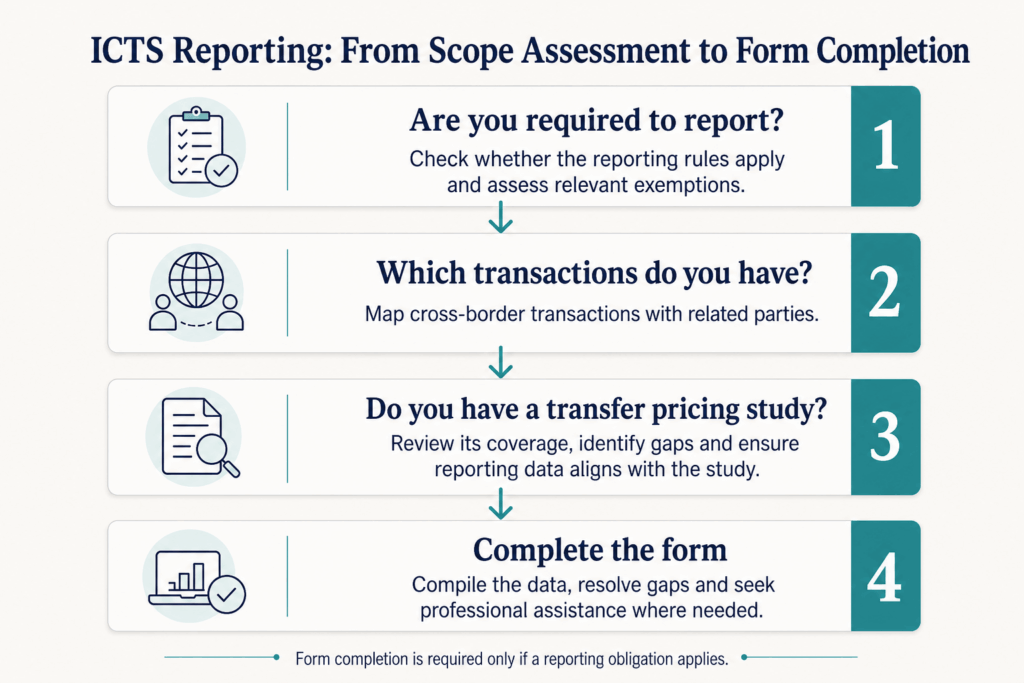
How should companies prepare?
Check whether you are required to report
The first step is to assess the applicability of the rules and the exemptions. The relevant entities and activities in the United Kingdom should be identified, and it should be determined whether they are subject to a reporting obligation. There is no need to begin completing the form before understanding whether it is required.
Map the transactions with related parties
If a reporting obligation exists, the relevant cross-border transactions and activities should be mapped. The mapping should reflect the actual activity, identify the parties to each transaction, and be consistent with the agreements and accounting data.
Check whether a transfer pricing study exists and what it covers
Companies should examine whether a study exists, whether it is up to date, and which entities, periods, and transactions it covers. They should then check that the information intended to be reported is consistent with the study and identify any missing data or differences that require explanation, updating, or supplementation.
This is a substantive step: the form should reflect the transactions and their pricing in a manner consistent with the professional analysis supporting them, rather than presenting a separate or contradictory picture.
Collect the data and complete the form
After assessing applicability, mapping the transactions, and reviewing the study, the data should be collected, gaps should be completed, and the form should be prepared in accordance with the applicable requirements.
It is recommended to define who is responsible for collecting the information and who will perform a review before submission. The review should also include checking the consistency between the form, the transfer pricing study, and the accounting data. Where needed, a professional adviser can assist with assessing the obligation, completing the documentation, and preparing the form.
How can we help?
Nimrod Yaron & Co. specializes in Israeli and international taxation. Our team is composed of professionals with years of experience at the Israel Tax Authority, as well as experience at leading firms and law offices, bringing together legal and economic perspectives. We advise private and public companies, Israeli and foreign companies, global venture capital funds, and clients seeking focused advice in clear and practical language. We also work with a professional network of accounting firms and law offices around the world, enabling us to provide comprehensive support in cross-border matters.
Ahead of the new reporting obligation in the United Kingdom, we assist companies and groups in assessing whether they are required to report, mapping transactions with related parties, and checking whether an up-to-date transfer pricing study exists that covers the relevant activity.
We then assist in reviewing the consistency between the data intended for the form and the transfer pricing study, agreements, and accounting records, identifying and completing missing information, and completing the form in accordance with the applicable requirements. Where needed, we also review the need to prepare or update a study, in coordination with professionals in the United Kingdom as required.
This allows you to receive focused professional support, from assessing the reporting obligation through to preparing the report, while tailoring the work to the group’s activity and needs.
Frequently Asked Questions
I have a company in the United Kingdom. Will I need to file the new report?
Not necessarily. The applicability of the rules, the existence of international transactions with related parties, and the relevant exemptions should be reviewed in accordance with the applicable requirements.
What is the ICTS?
It is a structured annual report on international transactions with related parties, intended to help HMRC identify transfer pricing risks.
When is the new reporting obligation expected to begin?
According to the policy paper, the obligation is expected to apply to accounting periods beginning in January 2027 and thereafter, subject to the commencement date that will be set in the regulations.
We already have a transfer pricing study. Is that enough?
Not necessarily. It is necessary to check that the study is up to date and covers the relevant transactions, and that the data reported in the form is consistent with the study and the accounting records. In any event, the ICTS form will need to be completed.
Can we get help completing the form?
Yes. We can assist with assessing the reporting obligation, mapping transactions, reviewing consistency with the transfer pricing study (or preparing a new study, if needed), completing missing information, and completing the form.